Table of Contents
- Understanding Driveway Paver Materials
- Concrete vs Clay Pavers for Driveways: Which Material Lasts Longer
- Paver Thickness for Driveways: Getting the Right Specifications
- Driveway Paver Base Preparation: The Foundation of Durability
- Load-Bearing Capacity and Traffic Considerations
- Maintenance and Sealing to Extend Paver Life
- Design, Drainage, and Long-Term Performance
- Frequently Asked Questions
Last Updated: September 23, 2026
Understanding Driveway Paver Materials
Selecting durable driveway pavers starts with understanding what materials actually hold up under traffic and weather. The most common options, concrete, clay, and natural stone, each bring different strengths and weaknesses to the table.
Concrete pavers are manufactured in controlled environments, which means consistency. They’re uniform in size and color, making installation straightforward. Clay pavers, fired in kilns at high temperatures, develop a hardened surface that resists staining and weathering. Natural stone pavers like granite or limestone offer aesthetic appeal but require more careful handling during installation.
The real difference between materials comes down to how they respond to freeze-thaw cycles and traffic loads. A material that looks great in the showroom might crack or settle after a few winters if the base preparation isn’t right. At Venice Pavers, we’ve found that material choice matters far less than what sits beneath it. A properly prepared foundation can make even standard concrete pavers last decades. A poor base will fail any material within years.
Concrete vs Clay Pavers for Driveways: Which Material Lasts Longer
Concrete pavers are the most popular choice for residential driveways because they’re affordable and available in countless colors and patterns. They’re durable when properly installed, though they can develop hairline cracks over time and may fade in intense sunlight.
Clay pavers cost more upfront but often outlast concrete. The firing process creates a denser surface that resists staining, fading, and weathering better. Clay pavers are especially valuable in areas with heavy rain because the material’s structure handles moisture movement more gracefully than concrete.
Natural stone pavers, granite, bluestone, limestone, offer superior aesthetics and longevity. However, they’re significantly more expensive and some types (like limestone) are softer and more prone to wear in high-traffic areas.
The honest truth: the material difference is real, but it’s smaller than most people think. A concrete driveway with meticulous base preparation will outlast a clay driveway with poor drainage. The foundation determines durability far more than the paver itself. When you’re choosing between materials, prioritize how each one handles water movement and soil settlement rather than just comparing hardness ratings.
Paver Thickness for Driveways: Getting the Right Specifications
Paver thickness directly affects load-bearing capacity. Standard residential driveway pavers are typically 2.375 inches thick, which is adequate for passenger vehicles and light trucks. If your driveway will handle heavier loads, delivery trucks, RVs, or equipment, you’ll need thicker pavers, usually 3.125 inches or more.
Thickness alone doesn’t guarantee durability. A thin paver on a solid base can outperform a thick paver on unstable ground. The base preparation determines how effectively the paver distributes weight across the soil below. Pavers sitting on inadequate base material will flex and crack regardless of thickness.
When evaluating thickness specifications, also consider the paver’s overall structural integrity. Some manufacturers reinforce pavers with fiber additives or use specialized mixes that improve tensile strength. These engineering details matter more than raw thickness for long-term performance. Ask suppliers for load-bearing capacity ratings, not just thickness measurements.
Driveway Paver Base Preparation: The Foundation of Durability
This is where most driveway projects succeed or fail. A durable driveway paver installation depends entirely on what happens before the first paver goes down, and that starts with understanding your soil.
Soil Type Determines Base Depth
Not all base preparations are equal. The soil beneath your driveway dictates how deep and how densely you need to build your foundation. Clay soils, common in many regions, are problematic because they retain water and shift seasonally. Sandy soils drain better but compact less effectively and may require deeper bases to prevent settling. Silty soils fall between these extremes but can be unstable when saturated.
A proper site assessment should identify your soil composition before installation begins. Clay-heavy soils typically require 6-8 inches of compacted aggregate base, while sandy soils may need 4-6 inches. This isn’t arbitrary, it reflects how each soil type distributes and absorbs load. Contractors who ignore soil type and apply a one-size-fits-all base depth create the conditions for premature failure.
Standard Base Layer Structure
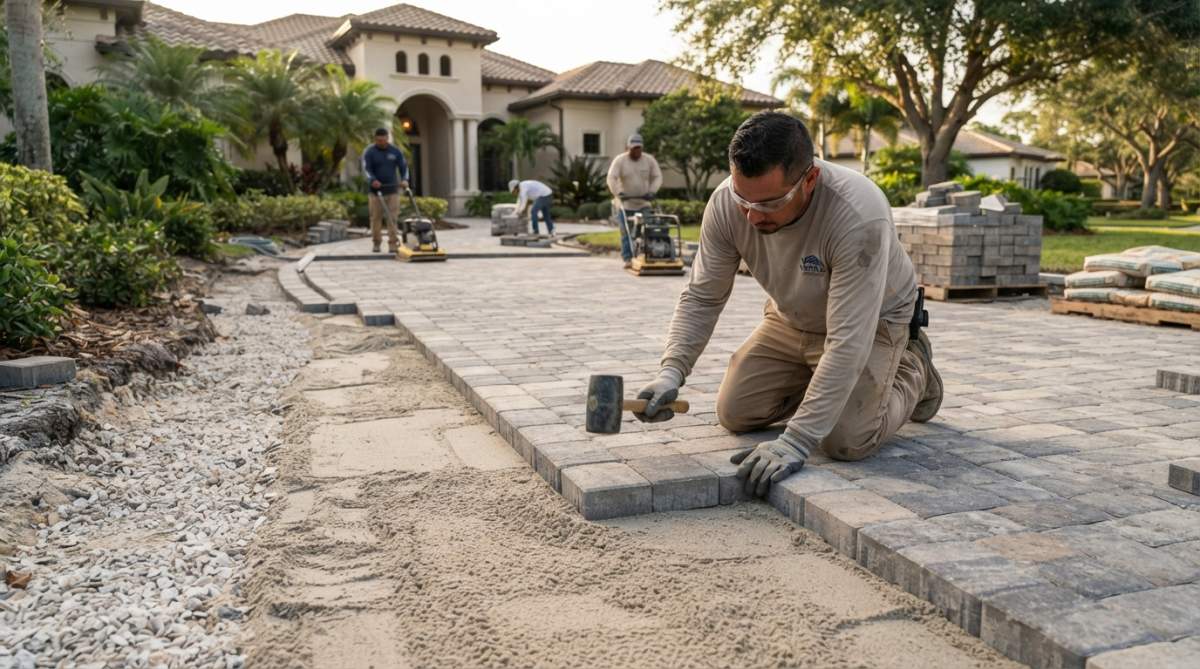
The base should consist of multiple layers: excavation to proper depth (determined by soil analysis), compacted aggregate (typically crushed limestone or recycled asphalt), and a final sand leveling layer. Each layer must be compacted to 95% of maximum density using mechanical compaction equipment. Most failures happen because contractors skip compaction, rush through it, or use hand-tamping instead of plate compactors or vibratory rollers.
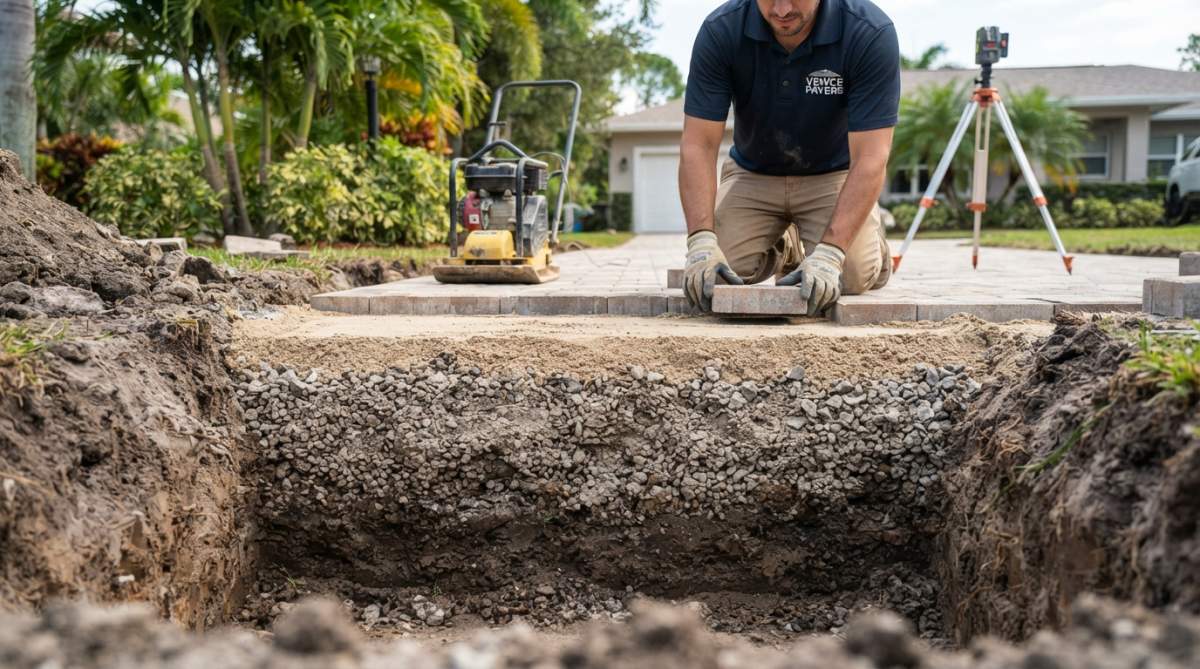
Proper compaction prevents settling. Pavers that settle unevenly create trip hazards and allow water to pool in low spots. Pooling water accelerates deterioration and can lead to joint instability. The polymeric sand used between pavers locks them together, but only if the base is stable enough to support that system.
Drainage and Water Management
Base preparation must account for water movement. In areas with high water tables or poor natural drainage, a permeable base layer allows water to flow through rather than accumulate beneath pavers. This is especially critical in clay soils, where water retention causes expansion and contraction cycles that destabilize the entire installation.
Slope the base slightly, typically 1-2% grade, to direct surface water away from low spots and toward drainage outlets. This prevents ponding and reduces the hydrostatic pressure that weakens base materials over time.
Compaction Verification
Free consultation & estimate →
Professional installers use compaction testing equipment to verify that base layers meet density specifications. Without testing, you’re relying on contractor judgment, which varies widely. Ask your installer whether they use a nuclear density gauge or similar verification method. This adds minimal cost but provides proof that the foundation meets engineering standards.
At Venice Pavers, we’ve seen countless repairs where the original installer cut corners on base prep. A driveway that looked perfect in year one was cracked and uneven by year three. Meticulous base preparation costs more upfront but eliminates callbacks and warranty issues down the road. Long-term structural integrity depends just as much on consistent upkeep as it does on initial installation, a reality explored further in our driveway maintenance guide.
Load-Bearing Capacity and Traffic Considerations
Understanding load-bearing capacity helps you choose pavers matched to actual use. But capacity ratings are only meaningful when you understand what they measure and how they depend on installation quality.
Residential vs. Commercial Load Requirements
Residential driveways typically experience 2,000-4,000 pounds per square inch (PSI) of pressure from passenger vehicles. A typical sedan weighs 3,000-4,000 pounds distributed across four tire contact patches, each roughly 20-30 square inches. This translates to moderate, intermittent loading.
Commercial driveways, delivery routes, and high-traffic areas need pavers rated for 6,000+ PSI. Heavy trucks (delivery vans, dump trucks) can exceed 10,000 PSI in localized areas. If your driveway will handle occasional heavy vehicles, RVs, construction equipment, or delivery trucks, you need pavers rated for at least 6,000 PSI.
Concrete pavers typically range from 3,500 to 8,000 PSI depending on mix design and curing. Clay pavers often exceed 10,000 PSI due to their fired density. Natural stone varies widely: granite and bluestone typically exceed 15,000 PSI, while softer stones like limestone may only reach 4,000-6,000 PSI.
Why PSI Ratings Assume Perfect Installation
Manufacturer load-bearing ratings assume proper base preparation. A paver rated for 6,000 PSI will fail quickly if the base compaction is inadequate or if soil conditions create settling. The rating is only valid when installation follows specifications exactly.
This is critical: a high-PSI paver on a weak base will fail faster than a lower-PSI paver on a properly prepared foundation. Load-bearing capacity is a material property, but durability is a system property. You cannot separate the paver from what’s beneath it.
Static vs. Dynamic Loading
Consider both static load (a parked vehicle) and dynamic load (repeated traffic). Dynamic loading is more demanding because it creates repeated stress cycles. Each vehicle pass flexes the paver slightly; over thousands of cycles, this flexing causes micro-fractures and joint degradation.
A driveway that handles occasional heavy vehicles needs different preparation than one experiencing daily traffic from multiple vehicles. If your driveway is a secondary route or rarely sees heavy use, standard residential-grade pavers on a properly compacted base will perform well. If it’s a primary access route or will see frequent use, upgrade to commercial-grade pavers or thicker residential pavers (3.125 inches instead of 2.375 inches).
Matching Paver Specifications to Soil Type
Soil type affects how effectively pavers distribute load. Sandy soils are more forgiving because they compact uniformly and drain well. Clay soils are problematic because they shift seasonally and retain water, which reduces their load-bearing capacity.
Maintenance and Sealing to Extend Paver Life
Sealing durable driveway pavers protects against staining and weathering while extending their lifespan significantly. Sealer fills the pores in concrete pavers and creates a protective layer that resists oil, water, and UV damage.
Design, Drainage, and Long-Term Performance
Aesthetic choices directly impact durability. Certain patterns distribute load more effectively than others. Herringbone patterns, for example, create interlocking geometry that resists movement better than running bond patterns. This isn’t just theory, it’s why herringbone is standard in commercial applications.
Frequently Asked Questions
What thickness of paver is required for a driveway?
Residential driveways typically require pavers between 2.375 and 2.75 inches thick, with 2.375 inches being the most common standard. Heavier-use areas or commercial installations may call for thicker pavers. The thickness you choose affects load-bearing capacity and long-term durability. Consult with a professional to determine the right specification for your soil conditions and expected traffic.
Are concrete or clay pavers more durable for driveways?
Concrete pavers offer excellent durability and load-bearing capacity at a lower cost, while clay pavers provide superior color retention and aesthetic appeal. Concrete is often chosen for its strength and consistency, whereas clay excels in areas where appearance and long-term color fading resistance matter most. The best choice depends on your climate, budget, and design priorities.
How does base preparation affect paver durability?
Base preparation is critical to durability. A properly compacted sub-base prevents settling, frost heave, and uneven surfaces that lead to cracking and drainage problems. The base must include adequate compaction in layers, proper slope for drainage, and edge restraint to keep pavers stable under traffic. Skipping or rushing base preparation is the leading cause of premature paver failure, making this step worth the investment.
What should I expect to pay for a durable driveway paver installation?
Pricing depends on paver material, driveway size, soil conditions, base preparation complexity, and regional labor costs. Concrete pavers typically cost less than natural stone or clay, while extensive drainage work or difficult grading increases the total investment. Contact Venice Pavers for a free consultation and estimate tailored to your specific property and requirements.