Last Updated: October 28, 2026
Quick Summary
The right yard drainage solution for a flat yard depends on the cause of the standing water, so diagnose first. Start with downspout extensions and grading, since many soggy lawns improve after these steps alone. If water still pools, choose a dry well, a French drain, or a surface channel based on your soil and whether a clear outlet exists.
- Extend downspouts several feet away from the house and clear gutter debris first.
- Dig a 18 inch test hole and time how long water takes to drain.
- A French drain needs about 1 percent fall, so a flat lot needs a manufactured outlet.
- A dry well stores runoff and only works if the surrounding soil absorbs water.
- Never route a drain toward a neighbor’s property, foundation, or septic drain field.
Table of Contents
- Why Flat Yards Hold Water and Where Drainage Fails
- How to Fix a Soggy Backyard Before Choosing a System
- Measuring Grade and Testing Soil Infiltration on a Flat Lot
- French Drain for Flat Yard: When a Trench Solves the Problem
- Dry Well for Yard Drainage: Underground Storage and Its Limits
- Grading a Flat Yard for Drainage and Surface Channels
- Choosing Your Flat-Yard Drainage Fix and Booking a Site Assessment
- Frequently Asked Questions
Standing water in a flat yard rarely comes from one cause, and the fix that works on a sloped lot can make a flat one worse. This guide explains how to choose among the main yard drainage solutions for flat properties, starting with the diagnosis. Most homeowners reach for a system before they know where the water is coming from, which is why so many drains fail to dry the lawn.
Why Flat Yards Hold Water and Where Drainage Fails
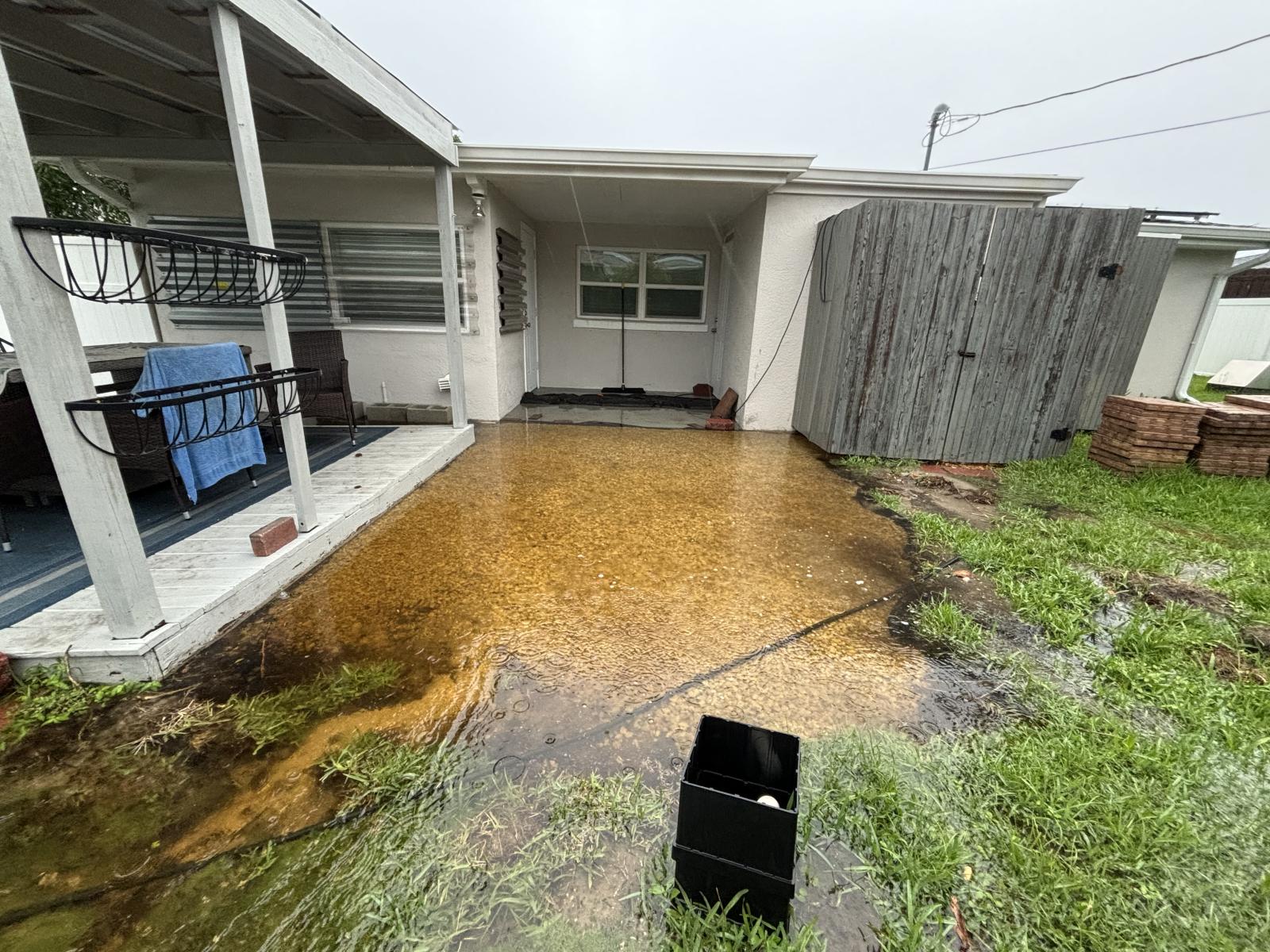
A flat yard holds water because there is no slope to carry it away. Surface water sits where it lands, soaks slowly into the soil, and pools in low spots until evaporation or infiltration catches up.
Common causes of standing water and soggy lawns
Standing water usually traces back to a few sources: roof runoff from downspouts, compacted soil that will not absorb rain, a high water table, or a low spot the eye misses. If you’re unsure whether your yard needs drainage at all, Signs Your Yard Needs Drainage lists the warning signs to check. Identify which one applies before you spend money on a fix.
Clay soil, compaction and the water table
Clay soil drains slowly, and compacted soil drains even more slowly. A high water table limits how far water can soak down. Any system you install has to discharge somewhere, so the outlet point matters as much as the trench or pipe itself.
How to Fix a Soggy Backyard Before Choosing a System
Start with the cheapest changes. Extend downspouts several feet away from the house, clear debris from gutters, and rake soil to fill small depressions. To judge whether roof runoff is contributing to the soggy lawn, read Downspout Drainage Solutions Explained.
If water still pools after these fixes, the problem is a drainage gap rather than a surface issue. At that point, a targeted system makes sense.
Measuring Grade and Testing Soil Infiltration on a Flat Lot
A flat lot can still carry a slight grade, often less than an inch of fall across 10 feet. Use a string line and a level to find the high and low points before you dig. Mark where water collects after a heavy rain and note how long it takes to drain.
For a basic infiltration test, dig a hole about 18 inches deep, fill it with water, and time how long the water takes to disappear. Slow drainage points to clay or compaction, which favors a trench or surface channel over a dry well.
French Drain for Flat Yard: When a Trench Solves the Problem
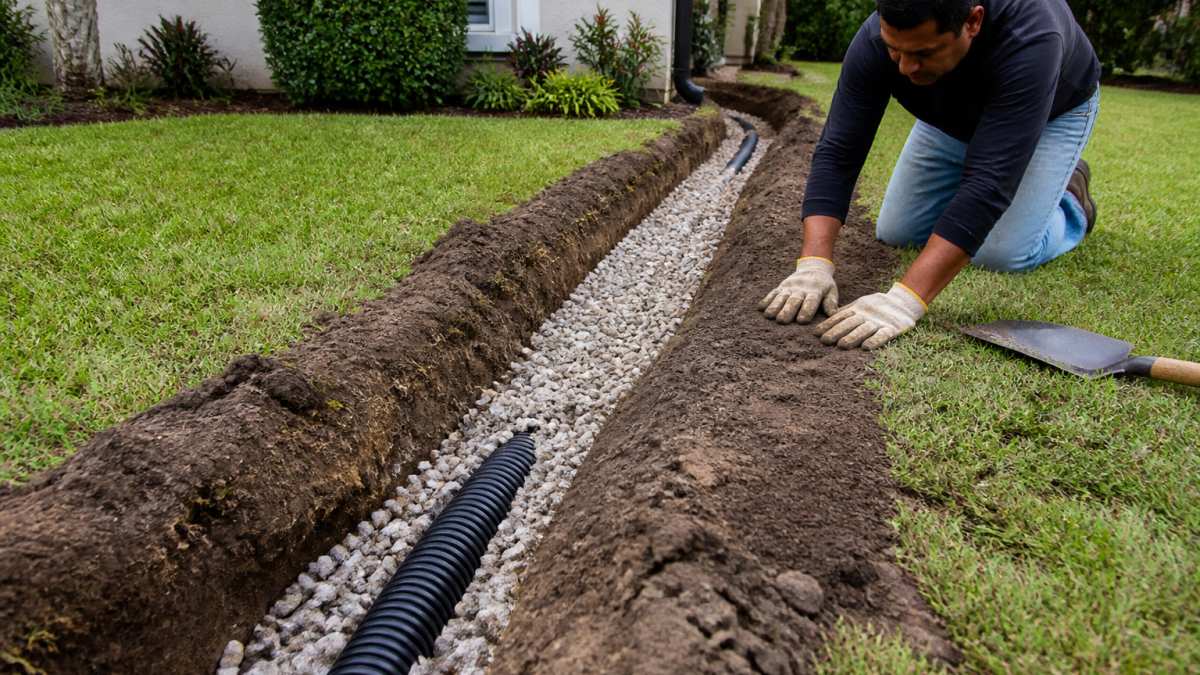
A French drain is a gravel-filled trench with a perforated pipe near the bottom, wrapped so soil does not migrate into the gravel. For a direct comparison of the two trench-style options, see French Drain Vs Channel Drain. It intercepts groundwater and surface runoff and carries it to an outlet. On a sloped lot, gravity does most of the work. On a flat lot, the trench only performs if you can create fall and find a place for the water to go.
The flat-lot constraint
A French drain needs a continuous slope along the pipe, typically about 1 percent (roughly 1 inch of fall per 8 feet of run) so water moves rather than sits. To see how drainage solutions are applied to a related hard-surface area, check out Drainage Solutions For Pool Decks. On a flat property, that fall has to be manufactured by digging the trench deeper at the outlet end, or by routing the pipe to a lower discharge point such as a daylight outlet, a dry creek bed, a storm drain (where allowed), or a sump pit with a pump. If none of those exist, a conventional gravity French drain will not drain, it will just fill and back up.
When it is the right tool
- A wet band or groundwater seep crosses the yard after storms.
- You have a legitimate outlet at lower elevation, even if only a few inches lower across a long run.
- Soil is clay or compacted and surface water needs to be intercepted before it pools.
When it is the wrong tool
- No outlet exists and regrading is not possible, a dry well or sump pump is a better fit.
- The water table sits at or above the trench bottom, so the pipe stays submerged.
- The yard is too small to fit the trench length needed to reach fall.
Cost and maintenance expectations
Pricing depends on trench length, depth, soil conditions, gravel and pipe quantities, outlet work, and whether a pump is needed, so a site visit is the only way to get an accurate figure. Plan on inspecting the outlet and cleanout annually, flushing the pipe if flow slows, and refreshing gravel or filter fabric if sediment reaches the pipe. A properly built trench can serve for decades; a poorly outlet one can clog within a season.
Dry Well for Yard Drainage: Underground Storage and Its Limits
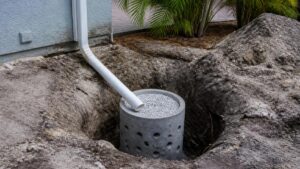
A dry well is an underground chamber, often a precast or plastic vault, sometimes a gravel-filled pit, that stores runoff and lets it soak into the surrounding soil over time. It is a storage-and-infiltration solution, not a conveyance solution, which is why it behaves very differently from a French drain on a flat property.
Free consultation & estimate →
Why flat lots often need a dry well
On a flat property, the hardest part of drainage is finding an outlet. A dry well sidesteps that problem by making the soil itself the outlet. That makes it attractive for roof downspouts, small low spots, and corners of the yard where a surface discharge is not practical or not permitted.
The soil test that decides whether it works
A dry well only performs as well as the soil around it can absorb water. Before committing, dig a test hole about 18 inches deep, fill it with water, and time how long it takes to drain. If the hole still holds water after several hours, the soil is too tight for a dry well and you should look at a surface channel, regrading, or a sump pump instead. Clay, compacted fill, and high groundwater are the three conditions that most often cause dry wells to fail.
Sizing and placement
A dry well has to be sized to the volume of water it receives, not to the size of the yard. A downspout serving a few hundred square feet of roof needs far less capacity than one serving the whole house. Place the well away from the foundation, away from property lines, and away from any septic system or utility easement. Local rules may govern setback distances and whether infiltration is allowed at all.
Cost and lifecycle
Installed cost depends on vault size, excavation, gravel, and connection work, so an accurate figure requires a site assessment. Maintenance is modest but real: inspect the inlet and any filter annually, remove sediment and leaves before they reach the chamber, and watch for ponding over the well after storms, that is the first sign the soil or the chamber is clogged. A well-sited dry well can last for decades; one placed in tight clay can stop working within a few seasons.
Dry wells pair well with downspout extensions and grading, and they are often the simplest option when a flat lot has no legal or practical surface discharge.
Grading a Flat Yard for Drainage and Surface Channels
Regrading is often the most effective long-term fix. Even a gentle, consistent slope of about 1 to 2 percent moves water away from the house without a buried system.
Keep grading work away from the foundation. Water should slope away from the house, not toward it, and any channel should lead to a place where the water can actually leave the property.
Here is a quick summary of the main options covered in this guide, so you can see which fits your yard.
|
Option |
Best for |
Key difference |
|---|---|---|
|
Grading and surface channels |
Surface water after rain |
Redirects water without buried parts |
|
Dry well |
Slow soakage in one area |
Stores runoff and lets soil absorb it |
|
French drain |
Groundwater or a wet band |
Needs a clear lower outlet |
|
Downspout extensions |
Roof runoff pooling near the house |
Cheapest first step |
Choosing Your Flat-Yard Drainage Fix and Booking a Site Assessment
Choose the solution based on your findings. Use this simple decision path: to compare which drainage approach best suits Florida yards before booking, see Best Drainage Solution For Florida Yards.
- Surface water after rain: start with grading and downspout extensions.
- Slow soakage in one area: consider a dry well or a rain garden.
- Groundwater or a wet band across the yard: a French drain with a clear outlet is usually the right tool.
Each option has trade-offs in cost, maintenance, and performance, and the right answer depends on your soil and your outlet. Venice Pavers offers a free consultation and estimate. Contact us to book your assessment.
Frequently Asked Questions
How do you drain a flat yard with standing water?
Start by identifying where the water collects and where it can safely go. A flat yard usually needs a path to a lower point, such as a storm drain, curb, or a dry well, because gravity alone will not move it. Options include a French drain or surface trench to carry water to an outlet, targeted grading to create gentle slopes toward that outlet, and downspout extensions to keep roof runoff off the lawn. Test how fast the soil drains after rain, since slow clay soil often needs a surface channel rather than underground storage. Pricing depends on the length of trench, soil conditions, and the outlet you use.
Will a French drain work in a flat yard?
A French drain can work in a flat yard if the trench has a reliable outlet lower than the bottom of the pipe. Because the yard has little natural slope, the pipe must still carry water downhill, which means the outlet location decides whether the system functions. Gravel-wrapped perforated pipe handles subsurface water well, but it will not move water if the trench bottom is level or the outlet is blocked. Have the grade surveyed before digging, and confirm where the water will discharge so it does not flow onto a neighbor’s property.
Are dry wells effective for yard drainage?
Dry wells are effective where the soil drains reasonably well and the yard can absorb water into the ground below the surface. They store runoff in a gravel-filled pit and let it infiltrate over time, so they perform poorly in dense clay or where the water table sits close to the surface. A dry well is best used to collect concentrated runoff from roofs or a low spot, not as a fix for an entire lawn. Infiltration testing before installation shows whether the soil will accept the volume you expect.
What is the difference between a French drain and a channel drain?
A French drain is a trench with perforated pipe and gravel that collects water moving through the soil and carries it away underground. A channel drain is a surface grate set in a concrete or metal trough that captures runoff flowing across the ground. French drains suit saturated subsoil and seepage, while channel drains suit water sheeting over paved or hard surfaces. On a flat lawn, the choice often depends on whether the problem is water coming up from below or water arriving from the surface.