Last Updated: October 30, 2026
Quick Summary
A dry well can handle light, steady rain in Florida, but heavy, fast-falling storms often overwhelm it within minutes. Its performance depends on soil type, water table depth, and whether it is sized for the runoff it receives. A percolation test before building is the best way to check whether a dry well will work on your property.
- Sandy soils drain fast, while clay and compacted fill slow drainage considerably.
- Run a percolation test at the planned well depth before deciding to build.
- Size the well for the heaviest storm you expect, not the average rain.
- Use a French drain instead if your yard floods across a wide area.
- Call 811 and confirm local setbacks before any excavation.
Table of Contents
- How a Dry Well Handles Stormwater in Heavy Rain
- Why Florida Soil and High Water Tables Limit Dry Well Performance
- Running a Dry Well Soil Percolation Test Before You Build
- Sizing a Dry Well for a Specific Storm
- Dry Well vs French Drain for Florida Yards
- Why Backyard Flooding Persists After Heavy Rain and What to Check
- Dry Well Installation Requirements and Your Next Step
- Frequently Asked Questions
How a Dry Well Handles Stormwater in Heavy Rain
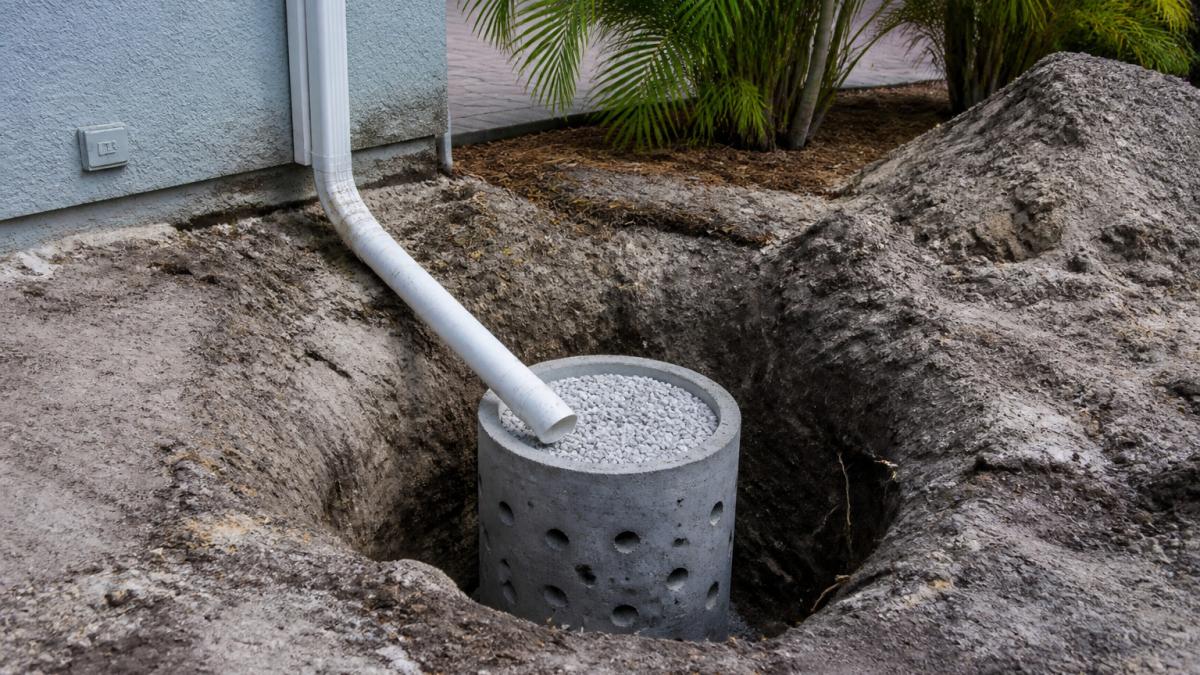
A dry well is an underground pit, usually filled with gravel or rock, that collects rainwater from a downspout or low spot and lets it soak into the surrounding soil (the EPA). In a moderate rain, it can keep a small area from pooling. Heavy Florida storms are a harder test, and the answer to whether one will work depends on the conditions below.
A dry well can handle light and steady rain. Heavy, fast-falling rain is different, because the water arrives faster than the ground can absorb it. That is where most problems begin.
What happens to runoff during a storm
Water enters the dry well from the surface, fills the void space in the gravel, and then slowly seeps into the soil below and around it. The rate it drains depends almost entirely on how quickly the soil takes in water.
A common mistake is sizing the well for the size of the yard instead of the amount of water flowing into it. A large roof area sending water through one downspout can overwhelm a small well within minutes.
Why Florida Soil and High Water Tables Limit Dry Well Performance
Florida’s sandy soils often drain well, but many yards also have layers of clay, compacted fill, or a shallow water table. Any of these can slow drainage.
When the ground is already saturated from days of rain, a dry well has nowhere to send its water. It fills, backs up, and the yard floods anyway. This is the main reason a dry well can look fine in a dry spell and fail during a storm season.
Here’s what to check on your own property:
- Soil type: Sand drains fast; clay drains slowly
- Water table depth: A high water table leaves little room for water to sink
- Previous flooding: Standing water after past storms is a clear warning sign
- Compacted areas: Construction fill or heavy foot traffic reduces absorption
Running a Dry Well Soil Percolation Test Before You Build
A percolation test measures how fast water drains through the soil at the depth where the well would sit. It is the simplest way to check whether a dry well is worth building.
To run a basic test:
- Dig a hole about 12 inches wide and 18 inches deep at the planned well depth.
- Fill it with water and let it drain completely.
- Refill it to 6 inches and measure how far the water level drops in 30 minutes.
- Repeat the test until the drop rate stays steady.
Water that drops slowly, or not at all, means the soil will not handle a dry well on its own. For the local causes of yard flooding and how they tie to drainage, see Why Yards Flood in Venice Florida. In that case, a different drainage method is usually a better choice.
Sizing a Dry Well for a Specific Storm
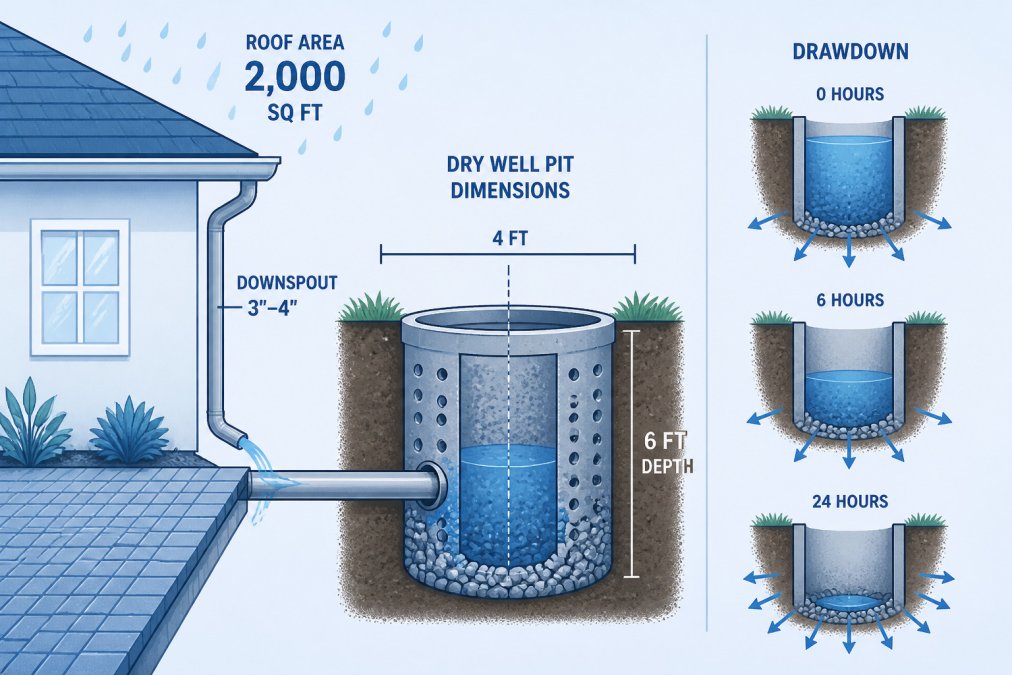
Most dry-well failures in heavy rain come down to sizing. A well that looks generous in a light shower can fill in minutes during a summer downpour. The fix is to size for a specific storm using three numbers: the drainage area feeding the well, the rainfall depth you want to handle, and the storage volume of the well itself.
Step 1: Estimate the runoff volume
Start with the area that sends water to the well. For a downspout, that is the roof area it serves. For a low spot, estimate the contributing yard or paved area. Convert everything to square feet.
Then multiply by the rainfall depth you want to capture, converted to feet. For example, a 1,000-square-foot roof draining to one downspout, sized for a 2-inch storm, gives:
- 1,000 sq ft × (2 in ÷ 12 in/ft) = about 167 cubic feet of runoff
That is the water volume the well must hold or drain during the storm. A common mistake is to size for average rain; a short, intense cell can drop an inch in 20 minutes, so plan for the heaviest storm you expect, not the typical one.
Step 2: Compare storage to inflow
Storage in a gravel-filled dry well depends on the void space between the stones, so the well must drain during the storm, not just store the water.
Step 3: Estimate drawdown time
Drawdown is how long the well takes to empty into the soil. Use the percolation rate from your soil test. If the test shows the water level dropping 1 inch in 30 minutes, that is a slow rate; sandy soil might drop several inches in that time. Multiply the well’s infiltration surface area by the soil’s intake rate to estimate how fast water leaves the pit. If drawdown time is longer than the gap between storms, the well will still be full when the next cell arrives.
Free consultation & estimate →
A practical rule of thumb
Sizing requirements vary with soil type and local conditions, so have the pit size confirmed by a professional who has tested the site. If your calculated runoff volume exceeds what the pit can store plus what the soil can absorb during the storm, the well is undersized and will back up.
Run the numbers before you dig. To see how landscape drainage is planned for heavy rainfall in Florida, review that guide alongside your calculations.
The article’s sizing steps come down to three numbers you can check against your own yard.
|
Item |
Value |
Note |
|---|---|---|
|
Roof area example |
1,000 sq ft |
One downspout in the example |
|
Rainfall depth sized for |
2 inches |
Converted to feet (2 ÷ 12) |
|
Runoff volume example |
About 167 cubic feet |
Area × rainfall depth in feet |
|
Percolation test hole |
12 in wide, 12 in deep |
Dug at planned well depth |
|
Percolation refill level |
6 inches |
Measure drop over 30 minutes |
|
Intense storm example |
1 inch in 20 minutes |
Plan for heaviest storm, not average |
Dry Well vs French Drain for Florida Yards
A dry well collects water at one point and disperses it underground. Proper installation of these systems prevents the saturation that eventually necessitates repairing water damage to your home interior.
A dry well works best for a single downspout or a small low spot. For an overview of the drainage systems suited to coastal Florida conditions, see Best Drainage Systems for Coastal Florida. You can see what a French drain installation in Venice, FL involves locally.
Best for: Homeowners with one concentrated source of runoff and sandy soil. Skip if: Your soil drains slowly or your yard floods across a wide area.
Why Backyard Flooding Persists After Heavy Rain and What to Check
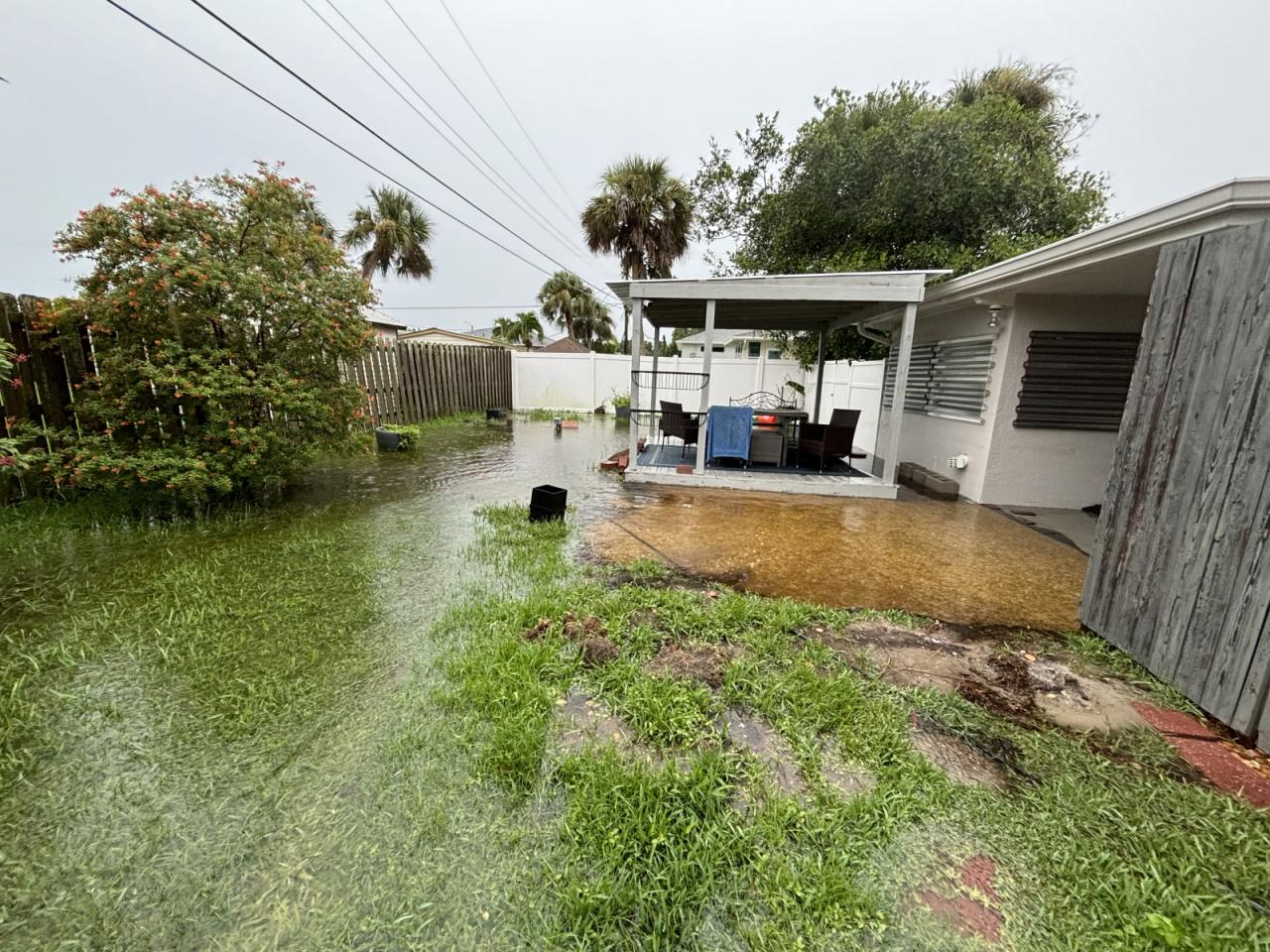
If your backyard still floods after a dry well is installed, the cause is usually one of three things: the well is too small, the soil is saturated, or water is reaching the well from a source you did not plan for.
Start with a walk-around during a storm. Note where water collects, where it flows, and whether the dry well is overflowing. Then check the grading. Ground that slopes toward the house or toward a low spot will keep sending water back to the problem area and creating yard flooding.
Dry Well Installation Requirements and Your Next Step
Before digging, confirm three things: where you can legally put the well, what is already underground, and how the well will overflow safely. Skipping these steps is the most common reason a dry well fails inspection or damages utilities.
Permitting and setbacks
Local building departments set setback distances from property lines, foundations, and septic systems. Setback requirements vary by jurisdiction, so confirm them with your local building department before excavation. Some areas also require a permit for any excavation deeper than a set depth or for systems tied to downspouts. Ask specifically about:
- Minimum distance from the house foundation and crawlspace
- Distance from property lines and easements
- Distance from septic tanks, drain fields, and wells
- Whether a permit or site plan is required
- Inspection requirements before backfilling
Utility locates
Call 811 before any excavation to have underground utilities marked (811 Before You Dig). Mark the proposed pit location with paint or flags, and wait for the locate service to respond before digging. Never assume a line is deeper than your pit; irrigation lines, gas lines, and fiber can be shallow.
Overflow planning
Every dry well needs a safe overflow route. When the well fills during a heavy storm, excess water must go somewhere that does not send it toward the house. Options include a graded swale, a pop-up emitter at a lower grade, or a secondary dry well. Plan the overflow before installation, not after the first backup.
Installation sequence
A typical installation follows this order: mark the pit, call 811, dig to the planned depth, line the pit if your method requires it, add gravel, set the inlet pipe from the downspout, and backfill. Keep the pit clear of compacted fill and do not set it in a low spot that collects water from the whole yard unless it is sized for that volume.
When to call a professional
If your soil test shows slow drainage, your yard floods across a wide area, or your planned pit is close to the foundation or utilities, have a professional review the site before digging. A contractor can run a percolation test, check grading, and tell you whether a dry well suits your yard or whether another drainage method makes more sense. Contact Venice Pavers for a free yard flooding and drainage consultation and estimate.
Frequently Asked Questions
Does a dry well work for heavy rain in Florida?
A dry well can help water leave the surface during heavy rain, but it works only when the soil absorbs water at a usable rate and the system has enough storage for the storm. In Florida, many yards have clay-heavy soil or a high water table, which slows drainage and can leave the well full. Before relying on one, test how fast your soil drains and size the system for a realistic storm. Without those checks, a dry well may overflow or back up during a large rain event.
How do I know if my soil can handle a dry well?
Dig a test hole roughly 12 inches deep and about 12 inches wide, fill it with water, and time how long the water takes to drain. Repeat the test after refilling to account for initial soak-in. Slow drainage, or water that stays for many hours, suggests poorly draining soil or a high water table. In that case, a dry well may not be the right choice and a different drainage method may work better.
Is a dry well better than a French drain for backyard flooding?
Neither option is better in every situation. A dry well collects roof or surface runoff in a single underground chamber, while a French drain moves water along a trench through a perforated pipe. A French drain often suits a yard where water moves across the surface toward a low spot, while a dry well suits a concentrated source such as a downspout. Matching the system to the water source and the soil matters more than the name.
What installation requirements should I check for a dry well?
Check your local permitting rules, property setbacks from structures and property lines, and the location of underground utilities before digging. Confirm the depth and sizing with a professional who has tested the site. Plan an overflow path so excess water has somewhere to go when the system fills. Requirements vary by county and municipality, so confirm them with your local building department before installation.