
Table of Contents
- How to Identify the Best Paver Contractors in Southwest Florida
- Essential Questions to Ask Paver Installers Before Hiring
- Paver Driveway Installation Best Practices for Florida’s Climate
- Understanding the Benefits of a Lifetime Workmanship Guarantee
- Comparing Material Options for Your Hardscape Project
- Permitting and Drainage Requirements for Southwest Florida Pavers
- Maintenance and Sealing for Long-Term Paver Performance
- Conclusion: Choosing the Right Paver Contractor
- Frequently Asked Questions
Last Updated: October 2, 2026
How to Identify the Best Paver Contractors in Southwest Florida
Finding the best paver contractors in southwest Florida starts with one question: who controls the outcome? Base preparation and drainage, not the surface pattern. Nail the base and your driveway sits flat after a decade of summer storms; skimp on it and you get sunken pavers within two seasons.
At Venice Pavers, we have spent more than 30 years installing driveways, patios, walkways, and retaining walls across the region. Failures always trace back to shortcuts taken before the first paver goes down.
Here is what separates a serious paver contractor from a crew with a truck and a weekend opening:
- Licensed and insured status you can verify. Ask for the license number and insurance certificate, then confirm both independently.
- Base depth matched to soil conditions. Sandy coastal ground and fill dirt behave differently. The sub-base plan should reflect your actual site.
- Written drainage design. Water has to go somewhere. If the proposal never mentions grading or runoff, that is a red flag.
- A workmanship guarantee in writing. Not a verbal promise. A document with terms.
- Local project history. Contractors who work in your area understand the soil, the storm patterns, and the permitting office.
Essential Questions to Ask Paver Installers Before Hiring
A short, direct question list separates competent paver installers from persuasive ones. Ask these before accepting any proposal:
- How deep will you excavate, and what goes into the sub-base? You want a specific answer with material types and depths, not “we’ll do it right.”
- How will you handle drainage on my property? Look for grading, slope, and runoff direction.
- What does your workmanship guarantee cover, and for how long? Get it in writing.
- Who is on the crew, and are they employees or subcontractors? This affects accountability.
- Can you show me completed projects nearby? Local references tell you more than a photo gallery.
- How do you handle permits? In many cases the contractor pulls them, but confirm who is responsible.
- What is the payment schedule? Large upfront deposits are a warning sign.
A reliable contractor answers all seven without hesitation. Vague answers on base prep or drainage are your signal to keep looking. If you want to see how a professional team handles these questions, the U.S. Federal Trade Commission’s guidance on hiring contractors outlines the consumer protections that apply to home improvement work.
Paver Driveway Installation Best Practices for Florida’s Climate
Florida’s climate punishes shortcuts.
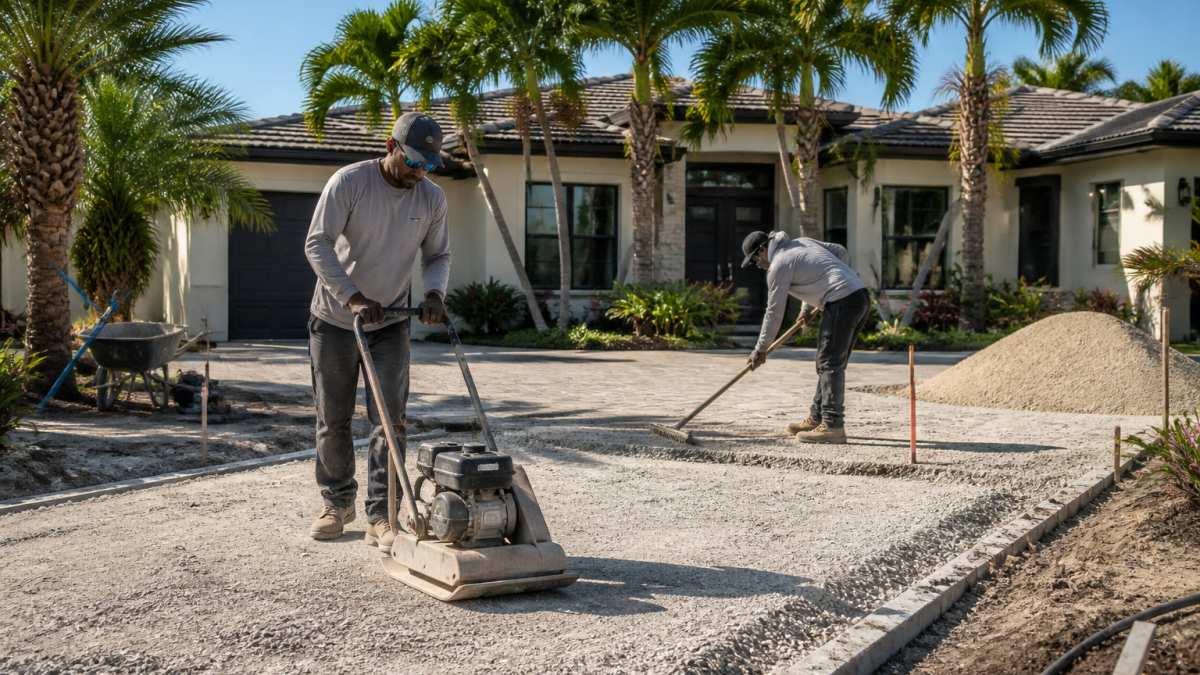
Start with the sub-base. Contractors excavate several inches below final grade, then lay and compact crushed stone in lifts.
Next comes bedding sand, screeded to a consistent depth, then the pavers and edge restraints that lock the field in place.
Here is what most guides skip: on a driveway, the base carries vehicle weight, not just foot traffic.
Understanding the Benefits of a Lifetime Workmanship Guarantee
A lifetime workmanship guarantee is a written commitment to fix defects caused by installation error, not just material failure.
Manufacturer warranties cover the product, rarely settling, shifting, or poor drainage.
A genuine workmanship guarantee should spell out:
- What is covered (settling, shifting, uneven joints, drainage failures)
- What is excluded (damage from vehicles beyond normal use, root intrusion, neglect)
- How long it lasts and whether it transfers if you sell the home
- How to file a claim and what the response time looks like
Venice Pavers backs installations with a lifetime workmanship guarantee because we control the variables that cause failures.
Read the guarantee before you sign. A one-line promise on an invoice is not the same as a documented policy.
Comparing Material Options for Your Hardscape Project
Material choice drives appearance, upkeep, and how the surface handles salt air, humidity, and intense UV.
|
Material |
Look |
Maintenance Level |
Best For |
Relative Cost |
|---|---|---|---|---|
|
Uniform, many colors |
Low |
Driveways, patios |
Lowest |
|
|
Brick pavers |
Classic, warm tones |
Moderate |
Walkways, accents |
Moderate |
|
Natural stone |
Unique, textured |
Moderate to high |
Pool decks, entries |
High |
|
Travertine |
Cool, elegant |
Low |
Pool decks, patios |
High |
|
Shellstone |
Soft, coastal |
Moderate |
Pool decks, lanais |
High |
Concrete pavers dominate residential paving because they balance durability, price, and repairability.
Natural stone and marble pavers deliver variation no manufactured product matches.
Travertine stays cooler underfoot than almost any other option, which is why it shows up so often on pool decks and lanais.
Shellstone is a regional favorite for coastal properties.
Free consultation & estimate →
How to think about cost
Price per square foot is the number homeowners ask about first, and the one most contractors avoid putting in writing until they have walked the site, because cost depends on excavation depth, base material, access, and pattern complexity, not just the surface product.
When you compare quotes, ask each contractor to break the number into three parts: base preparation, materials, and labor.
The right choice depends on where the surface sits, how much traffic it takes, and how much upkeep you want. A good contractor walks you through those trade-offs instead of steering you toward whatever is in stock.
Permitting and Drainage Requirements for Southwest Florida Pavers
Permits and drainage are the two items homeowners underestimate most, and the two that can turn a finished project into a problem at resale. Understanding who regulates what makes the permitting conversation far more productive.
Who regulates what
Hardscape permitting in this region runs through three layers:
- County or municipal building departments issue the actual permits. Requirements vary by jurisdiction, and a project that is exempt in one county may require a full submittal in the next.
- Water management districts set stormwater rules when a project adds impervious surface above local thresholds. A large driveway or an expanded patio can trigger review because it changes how water leaves the lot.
- Homeowners associations impose their own design and material approvals on top of any government permit. HOA approval is separate from a building permit, and one does not substitute for the other.
Typically, small patios and walkways fall below permit thresholds, while driveways, pool decks, and any project that increases impervious coverage beyond a local limit require review. Because thresholds differ by jurisdiction, check with the authority having jurisdiction for your address before work begins.
What triggers a stormwater review
Stormwater rules exist because impervious surfaces send water somewhere it did not used to go. When a project adds enough hard surface, the reviewing agency may require a plan showing where that water ends up, meaning the contractor must demonstrate runoff is directed away from structures and toward approved discharge points, not onto a neighbor’s lot or into a drainage easement.
A solid drainage plan includes:
- Correct slope away from the home, typically a gentle grade rather than a steep one
- Channel drains or French drains where water collects against a wall or in a low spot
- Permeable options where runoff volume is a concern or where the lot is already close to its impervious limit
- Coordination with existing gutters and downspouts so roof water and surface water do not fight each other
Questions that separate prepared contractors from the rest
- Which jurisdiction issues the permit for my address, and have you pulled one there before?
- Does my project trigger a stormwater review, and if so, who prepares the plan?
- Will you handle the HOA submittal, or is that on me?
- What happens if the inspector requires changes mid-project?
- Who is listed as the contractor of record on the permit?
A team that works locally will know the process cold and can usually answer these without checking. A team that hesitates is either new to the area or planning to skip the step, information you want before you sign.
Maintenance and Sealing for Long-Term Paver Performance
Maintenance is where a good installation keeps paying off. Pavers are not set-and-forget, but the upkeep is modest compared to the lifespan you get in return.
Sealing is the highest-value step. A quality sealer locks in joint sand, resists stains, and slows color fading from UV exposure.
Routine care is simple:
- Sweep regularly to keep grit out of the joints
- Re-sand joints when they thin out
- Rinse with a hose, and spot-clean stains promptly
- Address any settling early, before it spreads
Paver repair is one of the quiet advantages of this surface. Because units are individual, a damaged section can be lifted, the base corrected, and the pavers reset.
The thing nobody tells you about paver maintenance is that most of the cost sits in the first sealing and then drops off. Skip sealing for years and you will spend more restoring the surface than you would have spent maintaining it.
Conclusion: Choosing the Right Paver Contractor
The hard part is not finding someone who can lay pavers. It is finding someone who will build the base and drainage correctly, then stand behind the work for years. That combination is rarer than it should be.
Venice Pavers has installed custom hardscape across Southwest Florida for over 30 years, with a certified Tremron installation team, licensed and insured status, and a lifetime workmanship guarantee on every project. From base preparation and drainage planning to the final joint sand, we handle the details that decide whether your driveway still looks right in ten years. Get started with Venice Pavers and request a free consultation and estimate for your driveway, patio, or outdoor living space.
Frequently Asked Questions
What should I look for when hiring a paver contractor in Southwest Florida?
Focus on three things: licensing and insurance, base preparation methods, and local experience. Ask for proof of a state or county license and a certificate of insurance. In Southwest Florida, contractors must account for high water tables and sandy soil, so ask how they handle grading and drainage. Request a written scope of work that details sub-base depth, compaction, and materials. A lifetime workmanship guarantee is also a strong signal that the contractor stands behind their installation.
How do I verify a paver contractor’s license and insurance?
Ask for their license number and insurance certificate, then verify both directly. In Florida, you can check a contractor’s license status through the Department of Business and Professional Regulation (DBPR) online portal. For insurance, request a Certificate of Insurance (COI) and call the listed insurer to confirm the policy is active and covers general liability and workers’ compensation. Never rely on a photocopy alone; confirm with the issuing agency. This step protects you from liability if a worker is injured on your property.
Why is base preparation critical for paver longevity in humid climates?
Southwest Florida’s sandy soil and frequent heavy rain make base preparation the single most important factor in how long pavers last. A properly compacted sub-base of crushed stone and bedding sand prevents shifting, sinking, and uneven surfaces. Without it, pavers can settle within a year, creating trip hazards and drainage problems. Ask contractors how deep they excavate, what compaction equipment they use, and how they test for proper drainage before laying pavers. Skimping on base work is the most common shortcut, and it always shows up later.
What are the benefits of a lifetime workmanship guarantee?
A lifetime workmanship guarantee covers installation defects for as long as you own the property. It typically includes issues like settling, shifting, or improper drainage caused by installation errors, not damage from misuse or extreme weather. This guarantee shifts the risk of poor workmanship from you to the contractor and signals confidence in their methods. Before signing, ask exactly what is covered, what voids the guarantee, and whether it transfers if you sell your home. Get the terms in writing.