Table of Contents
- Why Paver Driveway Drainage Fails (and How to Spot It Early)
- Permeable Paver Installation: How Water Moves Through the System
- Paver Driveway Slope Requirements and Grading Standards
- How to Prevent Sinking Pavers with Proper Base Preparation
- Regional Drainage Design for Southwest Florida’s Rainy Season
- Maintenance Tips for Permeable Pavers: Cleaning and Unclogging
- DIY vs. Professional Installation: Cost-Benefit and Long-Term Value
- Conclusion
- Frequently Asked Questions
Last Updated: September 25, 2026
Why Paver Driveway Drainage Fails (and How to Spot It Early)
Most paver driveway drainage problems start in the base, long before you see water sitting on the surface. At Venice Pavers, we’ve spent over 30 years installing hardscape across Southwest Florida, and the same pattern repeats: a driveway that looks perfect for a year, then sinks, pools, and shifts.
Signs of Poor Drainage: Pooling, Sinking, and Sediment Buildup
Watch for these warning signs, each pointing to a different failure in the system.
- Pooling water after rain that lingers more than an hour
- Sinking or dipping in the same spots, often near the garage or street
- Sediment buildup in the joints, which blocks water from draining
- Loose or rocking pavers that move when you step on them
- Weeds or moss growing in the joint lines
- Water stains on nearby walls or foundations
Ignoring sediment buildup in the joints is the most common mistake we see. Once the gaps clog, water has nowhere to go, and it starts working its way under the pavers. That’s when sinking begins.
Permeable Paver Installation: How Water Moves Through the System
Permeable paver installation means laying pavers with wider, open joints and a graded base so rainwater filters through the surface instead of running off. Water enters the gaps, passes through gravel, and either soaks into the soil or drains through a pipe system.
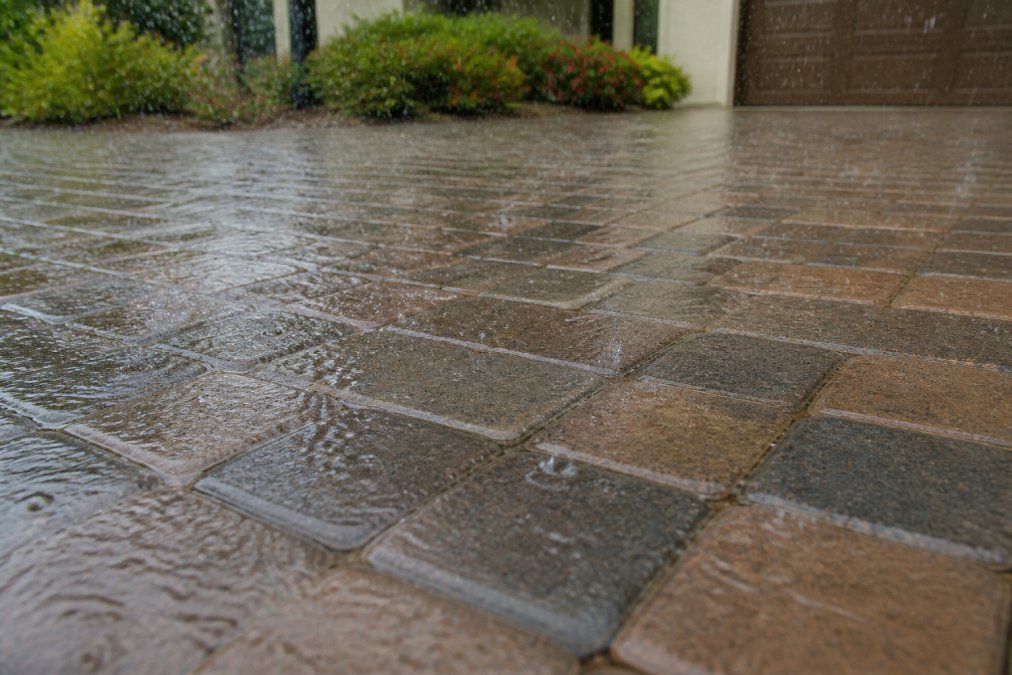
A permeable system has four working parts:
- The paver surface with open joints, usually filled with small gravel
- A bedding layer of fine aggregate that filters sediment
- A base layer of larger crushed stone that stores water
- The subgrade soil or a drain pipe that carries water away
Paver Driveway Slope Requirements and Grading Standards
Paver driveway slope requirements exist to move water away from your home toward a safe exit point. The typical target is a gentle 1 to 2 percent slope away from the building, roughly 1 to 2 inches of drop per 10 feet of run.
Grading standards also cover:
- Cross-slope so water doesn’t channel down one edge
- Positive fall away from the foundation and garage
- Swales or channels to guide water to a drain or lawn
- Edge restraint to hold the pavers in place on slopes
How to Prevent Sinking Pavers with Proper Base Preparation
Learning how to prevent sinking pavers comes down to three things: compaction, aggregate depth, and edge restraint. Skip any of them and the surface will move.
Compaction, Aggregate Depth, and Edge Restraint
Each base layer must be compacted in lifts, not dumped in one pass. Laying 8 inches of gravel at once and running a plate compactor over the top only compacts the first inch or two.
Here’s what a solid base looks like:
| Layer | What It Does | Common Failure |
|---|---|---|
| Compacted subgrade | Stable foundation | Not compacted before gravel |
| Base aggregate | Stores and moves water | Too shallow or one thick lift |
| Bedding sand | Levels the pavers | Too thick, causes shifting |
| Edge restraint | Holds the pattern | Missing or under-anchored |
| Joint fill | Locks pavers, lets water pass | Wrong material or overfilled |
We compact the base in lifts of 2 to 3 inches at a time. It takes longer, but it’s the single biggest reason our driveways hold up through years of heavy rain.
Regional Drainage Design for Southwest Florida’s Rainy Season
Southwest Florida’s rainy season delivers intense bursts, often several inches in a few hours, so a system sized for a steady drizzle will back up. The goal is not just to move water but to store it long enough for the soil and outlet to catch up.
Sizing the Base for Storm Volume, Not Average Rainfall
A permeable paver system works like a shallow reservoir: the open-graded base holds water while it percolates into the subgrade or exits through a drain. Too shallow, and it fills at the storm’s peak and the surface floods anyway.
- Storage volume = base depth × surface area × the void ratio of the aggregate (open-graded stone typically runs about 30-40% voids)
- Drawdown time = storage volume ÷ (subgrade infiltration rate × surface area)
Why Joint Spacing and Surface Intake Matter in Heavy Rain
During a burst, the surface becomes the bottleneck. Wider joints and clean, open-graded joint fill let water enter the base faster. Choked joints or fine, tight fill make the surface shed water like a standard paver driveway, and that runoff has to go somewhere.
A common pattern in this climate is to combine:
- Open joints with washed, angular joint aggregate (not masonry sand)
- A slight cross-slope so any surface overflow sheds toward a swale or lawn rather than the garage
- A positive fall away from the foundation so roof and driveway runoff do not converge at the same low point
Connecting the Driveway to the Rest of the Property’s Drainage
This is the step most homeowners and many installers miss: the driveway is one node in a larger site drainage system, not a standalone feature.
A practical sequence for a Southwest Florida lot:
Free consultation & estimate →
- Map the low points on the property and confirm where water naturally wants to go.
- Separate roof runoff from driveway runoff with independent outlets.
- Tie the driveway underdrain into a French drain or dry well only if the outlet can handle the combined volume.
- Daylight the outlet to a swale, curb, or storm structure, never let it dead-end against a foundation.
Before laying a single paver, we walk the lot after a heavy rain and watch where water actually pools. That 20-minute observation usually tells us more than any grading plan.
What Changes Between a Wet-Season Lot and a Well-Drained One
The same paver surface can need two very different bases depending on the subgrade. A sandy, well-drained lot may need only a modest open-graded base and no underdrain. Clay-heavy or seasonally saturated soil often needs a deeper base, a perforated underdrain at the low end, and a filter layer to keep fines out of the stone.
Maintenance Tips for Permeable Pavers: Cleaning and Unclogging
Permeable pavers only work if the joints stay open. Cleaning is simple but must be done on a schedule.
- Sweep the surface every few weeks to clear leaves and debris
- Rinse with a hose to check that water still drains
- Vacuum the joints with a shop vac once or twice a year
- Refill joint gravel as it settles
- Avoid sealers that close the surface and block water
- Keep nearby soil from washing onto the pavers
The single best maintenance habit is a quick water test after every big storm. If water drains within an hour, your system is working. If it pools, clean the joints before the next rain.
DIY vs. Professional Installation: Cost-Benefit and Long-Term Value
Most guides frame this as ‘hire a pro’ or ‘save money doing it yourself.’ The real question is which costs you pay now versus later, and how base prep changes that math.
The Cost Structure of Each Path
A DIY paver driveway shifts cost from labor to equipment, time, and risk. The line items that surprise first-timers:
- Excavation and haul-away, renting a mini-excavator and a dumpster, or paying for disposal
- Compaction equipment, a plate compactor for the base and a vibratory roller for larger areas; a plate compactor alone will not compact a deep base properly
- Aggregate delivery, open-graded base stone and bedding aggregate, often several truckloads
- Edge restraint and spikes, frequently skipped by DIYers, and the single most common cause of spreading edges
- Joint aggregate, washed, angular stone, not masonry sand
- Time, a typical two-car driveway is a multi-weekend project once excavation, base lifts, and compaction are done correctly
Where DIY Actually Works
DIY is a reasonable path when:
- The driveway is small (a single-car pad or a walkway)
- The subgrade is sandy and well-drained
- The slope is simple and already falls away from the house
- You can rent or borrow a vibratory roller, not just a plate compactor
- You are willing to compact in 2-3 inch lifts and verify each one
DIY is a poor fit for clay soil, a flat or reverse slope, an existing drainage problem, or a permeable system needing precise joint spacing and aggregate grading. Those are the conditions where a base mistake shows up after the first heavy rainy season, often just outside the window for recourse.
The Long-Term Value Calculation
The value of professional installation isn’t the pavers. It’s the base, slope, and edge restraint, the three things that determine whether the surface still drains in year ten.
A useful way to compare the two paths:
| Factor | DIY | Professional |
|---|---|---|
| Upfront cost | Lower (labor is yours) | Higher (labor and equipment included) |
| Equipment access | Rented, often undersized | Proper compaction and excavation equipment |
| Slope and grading | You verify | Verified against a plan |
| Edge restraint | Commonly skipped | Specified and anchored |
| Warranty | None | Workmanship guarantee |
| Failure risk | Borne by you | Borne by the contractor |
The most expensive outcome is not hiring a pro. It is a DIY base that fails after two rainy seasons and has to be torn out and rebuilt, you pay for the project twice.
A Decision Rule That Actually Helps
If the driveway is small, the soil drains well, and the slope is already correct, DIY can work. If any of those isn’t true, or the driveway is permeable and needs a specific base depth and joint aggregate, the base prep is the project, and that’s where professional installation earns its cost.
Compare the two paths on the base, not the surface. The pavers look the same either way; the base is what determines whether water still drains in year ten.
Conclusion
A paver driveway that drains well isn’t luck. It’s base prep, slope, and edge restraint working together, the difference between a surface that lasts decades and one that sags after a year.
Frequently Asked Questions
What is the best drainage system for a paver patio?
The best system combines a properly graded subbase, a permeable paver surface, and edge restraints that direct water away from the house. For Southwest Florida’s heavy rains, a slope of 1-2% away from structures plus a gravel-filled joint system works well. If your soil drains slowly, a perforated pipe under the base can carry excess water to a swale or storm drain, preventing surface pooling and protecting the base layer from saturation.
How do you prevent water from pooling on a paver driveway?
Water pools when the surface is flat or slopes toward the center. To prevent it, ensure a minimum 1% slope away from the garage and street, use permeable pavers with open-graded aggregate in the joints, and compact the subbase in 4-inch lifts. Also check that downspouts and gutters discharge away from the driveway. If pooling already happens, a contractor can re-grade the area or add a channel drain at the low point.
Can existing paver driveways be retrofitted with drainage solutions?
Yes, many driveways can be retrofitted without a full tear-out. Options include adding a channel drain along the garage apron, installing a French drain at the perimeter, or replacing a section of pavers with permeable ones. A professional will assess the base condition and slope first. If the base has settled or clogged, partial reconstruction may be needed to restore water infiltration and prevent future sinking pavers.
How does proper base preparation improve driveway drainage?
The base layer controls how fast water moves down and away. A well-compacted, open-graded aggregate base (typically 4-6 inches deep) stores water temporarily and releases it into the soil. Poor compaction leads to settling, which creates low spots and hydrostatic pressure that cracks pavers. Using the right aggregate size and compacting in lifts are key steps in permeable paver installation that directly affect drainage efficiency and structural integrity.