Table of Contents
- Why Paver Patio Drainage Matters
- How to Identify Standing Water in Your Backyard
- Paver Patio Slope Requirements and Grading Fundamentals
- Base Material Selection: Crushed Stone, Sand, and Compaction
- Channel Drain vs Surface Drain for Patios
- French Drains and Sub-Surface Drainage Systems
- Installing and Maintaining Your Paver Drainage System
- Conclusion
- Frequently Asked Questions
Last Updated: September 20, 2026
Why Paver Patio Drainage Matters
Poor drainage destroys patios. Water pooling on or beneath your paver patio causes cracking, shifting, and structural failure costing thousands to repair. A patio installed without proper drainage planning fails within 3-5 years; one built with meticulous base preparation lasts decades.
Standing water on the surface signals a grading problem; water trapped beneath signals base failure. Both are preventable with proper paver patio drainage planning from the start.
This guide covers everything you need to know about paver patio drainage solutions, from identifying existing water problems to installing systems that actually work.
How to Identify Standing Water in Your Backyard
Standing water appears as lingering puddles, wet spots, or moss growth. But the real problem often hides beneath the surface.
After heavy rain, observe whether water pools for more than a few hours (grading issue) or if the patio feels spongy underneath (poor sub-surface drainage and soil saturation).
Look for these warning signs of drainage failure:
- Pavers settling unevenly or rocking when you walk on them
- Cracks appearing in a pattern (usually linear, following the direction of water flow)
- Efflorescence (white powdery residue) on paver surfaces, which forms when water carries salts through the material
- Vegetation growing through joints or around edges, indicating persistent moisture
- Soft or muddy soil visible at the patio perimeter
If your patio sits lower than the surrounding yard, water naturally flows toward it, a grading problem requiring correction.
Paver Patio Slope Requirements and Grading Fundamentals
Proper slope is the foundation of paver patio drainage. Without it, water infiltrates the base material, causing hidden damage.
The industry standard is a minimum 1-2% slope: for every 10 feet, drop 1.2-2.4 inches. This is nearly invisible but moves water consistently.
Water must flow away from your house foundation. Grading toward your home creates hydrostatic pressure and basement moisture problems.
For irregular patios, establish primary and secondary slopes feeding water toward drainage channels or yard perimeter. Avoid low spots where water collects.
Common grading mistakes:
- Making slope too steep (over 3%), which causes pavers to feel unstable
- Creating a perfectly flat patio, which guarantees standing water and base saturation
- Sloping toward the house instead of away from it
- Failing to account for settling, which reduces slope over time as the base compacts
Account for future settling: crushed aggregate compacts over months, reducing slope. Meticulous compaction during installation prevents slope loss.
Base Material Selection: Crushed Stone, Sand, and Compaction
Your base is where drainage begins. Everything above depends on what you build below.
Crushed stone (aggregate base) is the primary drainage layer: typically 4-6 inches of crushed limestone, granite, or recycled asphalt. Angular edges create air gaps allowing water to flow downward and laterally.
Compaction is where most DIY attempts fail. Crushed aggregate must be compacted in 2-inch lifts to 95% density using a mechanical plate compactor. Hand compaction results in uneven settling and compromised slope.
Bedding sand (1 inch of coarse sand) sits directly under pavers as a leveling layer, not drainage. Fine sand holds water; use coarse sand rated for paver bedding.
Joint sand fills gaps between pavers. Polymeric sand (hardens when wet) resists erosion better than standard sand, but only works if the base drains properly.
The complete base structure from bottom to top:
- Soil subgrade (compacted native soil)
- 4-6 inches crushed aggregate base (compacted in lifts)
- 1 inch coarse bedding sand
- Pavers
- Joint sand (polymeric or standard)
This layering system is not optional for paver patio drainage solutions that last.
Channel Drain vs Surface Drain for Patios
When slope and grading alone can’t handle water volume, you need active drainage systems. The two main approaches serve different purposes and require different integration strategies, especially when connecting to existing structures.
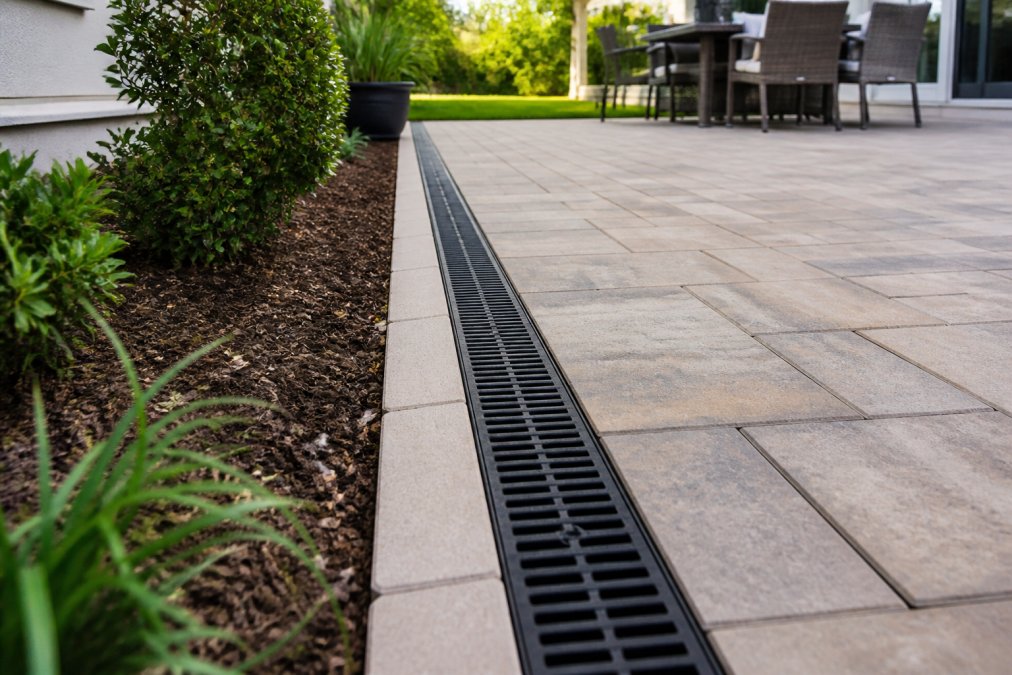
Channel drains are recessed channels directing water to a catch basin or downspout. Visible but highly effective for high water volume or poor natural drainage.
Integration with existing hardscapes and structures:
Free consultation & estimate →
French Drains and Sub-Surface Drainage Systems
French drains solve problems that surface drainage can’t reach: water trapped beneath the patio, rising water tables, and soil saturation that causes base failure.
French drains are essential when:
- Your property has a high water table or poor soil drainage
- You’re building on clay or other dense soil that doesn’t drain naturally
- Previous patios have failed due to saturation or settling
- Your patio sits in a low spot relative to surrounding grade
Installing and Maintaining Your Paver Drainage System
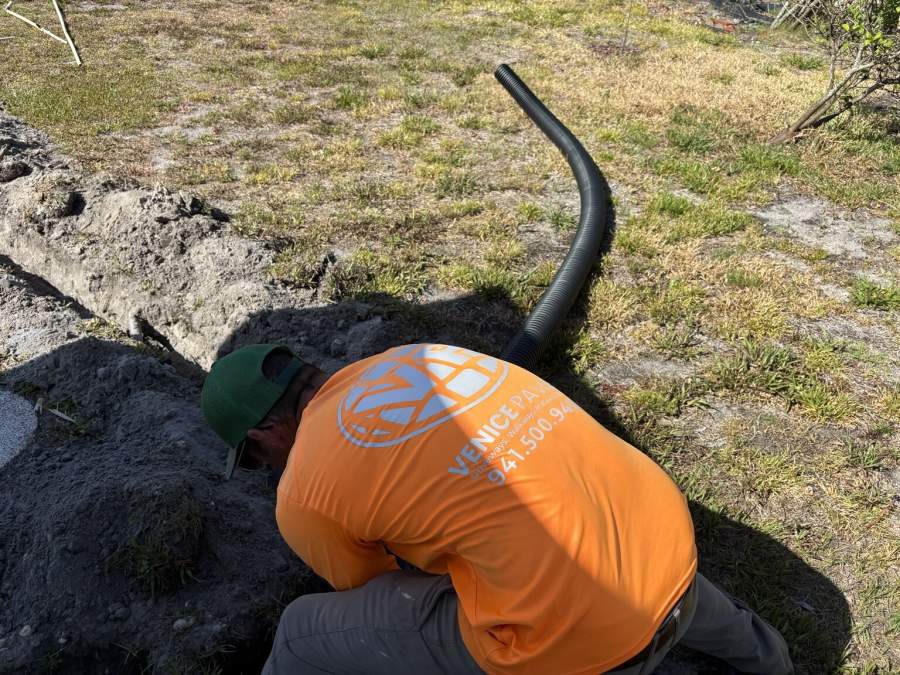
Professional contractor installing perforated drainage pipe in crushed stone base layer during patio construction, showing proper compaction and filter fabric placement
Installation sequence:
- Establish grade and slope using laser level or transit. Rushing this step is the most common contractor error.
- Excavate to proper depth, accounting for base material thickness, bedding sand, and paver height. Compact the subgrade.
- Install French drain (if required) before base material, ensuring pipe slopes toward exit and perforations face downward.
- Add crushed aggregate base in 2-inch lifts, compacting each fully. This is non-negotiable for paver patio drainage.
- Add 1 inch of coarse bedding sand, screeded level.
- Lay pavers in your chosen pattern. Avoid walking on completed sections until the entire patio is laid.
- Fill joints with polymeric or standard sand, then compact gently with a plate compactor.
- Allow polymeric sand to cure (24-48 hours) before water exposure.
Maintenance and Drainage System Longevity:
Seasonal inspection protocol:
- Spring: Inspect for settling or slope loss. Check French drain exits for debris. Clear leaves from surface drains.
- Summer: Water should drain within 2-4 hours. Persistent standing water indicates a grading problem.
- Fall: Clear gutters and downspouts. Inspect joint sand for erosion.
- Winter: Ensure French drain exits remain clear of ice.
Diagnosing and preventing common drainage failures:
Annual maintenance checklist:
- Walk the patio after rain and observe water flow. Does it drain within 2-4 hours? Does it flow away from the house?
- Inspect surface drains and channel drains for debris. Clear them.
- Check French drain exit points for water flow and blockages.
- Look for new low spots, cracks, or uneven settling.
- Inspect joint sand for erosion or displacement. Mark areas needing re-sanding.
- Check the patio perimeter for erosion or soil washout, which indicates water is not being directed properly.
- Verify that the patio slope is still visible (not flattened by settling).
Conclusion
Paver patio drainage solutions aren’t complicated, they’re just non-negotiable. A properly graded patio with the right base material and adequate drainage systems will serve you for 20+ years. One built without drainage planning fails within 5-10 years, often catastrophically.
Frequently Asked Questions
What is the best drainage system for a paver patio?
The best paver patio drainage system combines proper slope (typically 1% to 2%), a well-compacted crushed aggregate base, and either surface drainage (channel drains, catch basins) or sub-surface drainage (French drains, perforated pipe). The right choice depends on your soil type, water table elevation, and site conditions. A professional assessment determines whether your patio needs both systems or one primary approach to manage water runoff and prevent standing water.
How much slope is required for a paver patio to drain properly?
Paver patios typically require a minimum slope gradient of 1% to 2% to ensure adequate surface drainage. This means the patio should drop approximately 1 to 2 inches in elevation for every 10 feet of horizontal distance. Steeper slopes (up to 5%) may be necessary in areas with heavy rainfall or poor soil drainage. The slope directs water away from structures and toward drainage channels or the landscape, preventing pooling and hydrostatic pressure buildup beneath the patio.
How do I know if my patio has a drainage problem?
Signs of patio drainage failure include standing water that pools after rain, sunken or shifting pavers, efflorescence (white mineral deposits), algae or moss growth, and erosion around the patio edges. If water sits for more than 24 hours after rainfall, your slope or sub-base drainage is inadequate. Cracks in pavers and movement often indicate base failure caused by soil saturation and poor compaction. Early detection prevents costly repairs and structural damage to your outdoor space.
Can I use gravel alone for patio drainage?
Gravel alone is insufficient for reliable paver patio drainage. While crushed stone and aggregate provide permeability and allow water to filter through the base, they must be properly compacted and layered to prevent soil migration and maintain structural integrity. Gravel works best as part of a complete drainage system that includes proper slope, perforated pipe (if needed), and drainage channels. Without these supporting elements, gravel-only systems fail to manage surface runoff or prevent standing water effectively.
What causes paver patios to fail due to poor drainage?
Paver patio failures stem from inadequate slope (allowing surface runoff to pool), insufficient base compaction (causing settlement and hydrostatic pressure), poor sub-base material selection, and lack of drainage infrastructure. Standing water saturates the soil beneath the patio, weakening the aggregate base and causing pavers to shift or sink. Improper joint sand application and missing or clogged drainage channels prevent water from moving away from the structure. Professional installation with meticulous base preparation and drainage planning prevents these common failures.
Should I install a French drain under my patio?
A French drain is recommended if your property has poor natural drainage, a high water table, or existing moisture problems. French drains use perforated pipe surrounded by crushed stone and filter fabric to collect and redirect sub-surface water away from the patio. They work best alongside surface drainage and proper slope. If your site has good drainage and adequate slope, a French drain may not be necessary. A site assessment determines whether sub-surface drainage is needed to prevent water accumulation and base failure.
What is the difference between permeable and non-permeable paver systems?
Permeable paver systems allow water to drain through the surface into the sub-base, reducing runoff and supporting groundwater recharge. Non-permeable (solid) pavers shed water across the surface, requiring slope and drainage channels to direct water away. Permeable systems are ideal for environmental compliance and areas with drainage concerns, but they require proper base material to prevent soil migration. Non-permeable systems are simpler and work well with adequate slope and surface drainage channels. Both require proper base preparation and compaction.