Table of Contents
- What Permeable Paver Systems Are and How Permeable Pavers Work
- The Major Advantages of Permeable Paver Systems
- Permeable Pavers vs. Regular Pavers: Key Differences
- The Disadvantages and Limitations of Permeable Paver Systems
- Permeable Paver Maintenance: What You Actually Need to Do
- Permeable Pavers for Driveways: Performance and Durability
- Is a Permeable Paver System Right for Your Property?
- Frequently Asked Questions
Last Updated: October 10, 2026
What Permeable Paver Systems Are and How Permeable Pavers Work
Permeable paver systems are hardscape surfaces that let water infiltrate through the pavement into the soil below instead of creating surface runoff like concrete or asphalt.
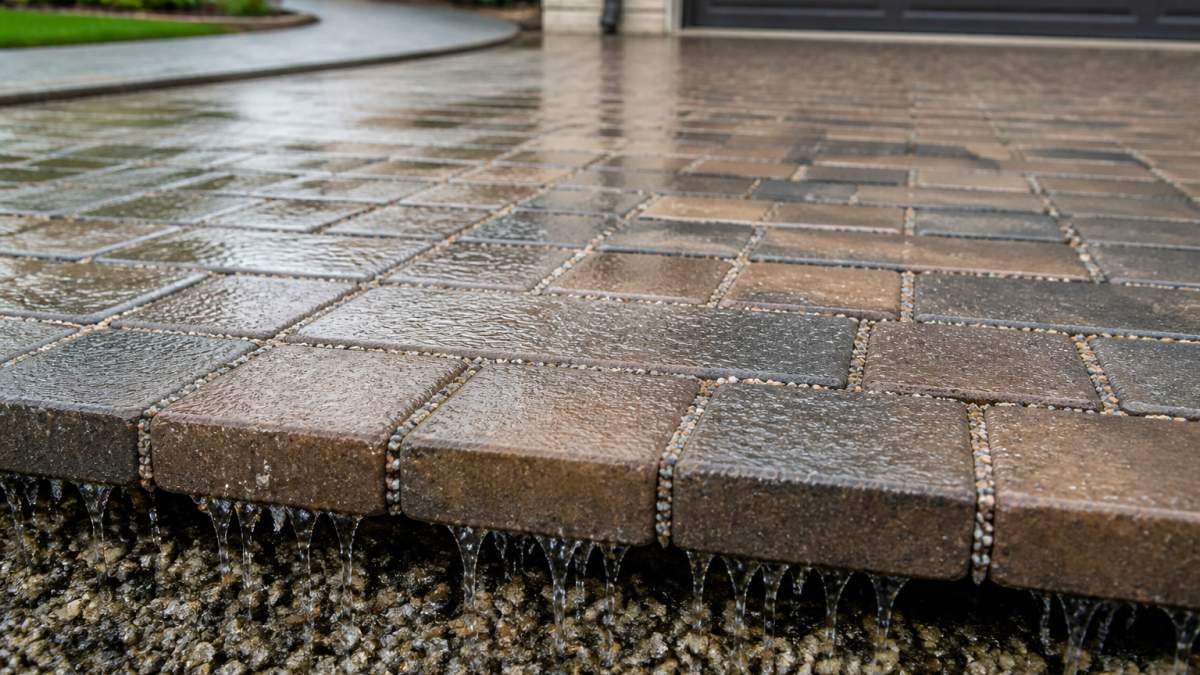
Rain passes through the joint aggregate, the porous base layers, and into the native soil, reducing stormwater volume that would otherwise overwhelm drainage infrastructure.
At Venice Pavers, we’ve installed hundreds of permeable paver driveways and patios across Southwest Florida, and the real performance difference comes down to base preparation, soil type, slope, and underdrain design, especially in flood-prone areas.
The Major Advantages of Permeable Paver Systems
Stormwater Management and Runoff Reduction
The primary benefit of permeable pavers is capturing and managing stormwater runoff. On traditional pavement, rainfall becomes surface runoff almost immediately, overwhelming municipal stormwater infrastructure during heavy rain.
A properly designed permeable paver system infiltrates 80-95% of rainfall into the soil during normal events, reducing localized flooding and easing the burden on aging stormwater systems.
For residential properties, that means less pooling in driveways and reduced erosion around foundations; for commercial sites, fewer drainage headaches.
Groundwater Recharge and Water Quality Benefits
Permeable pavers also support groundwater recharge: water that infiltrates through the system and aggregate subbase eventually reaches aquifers, replenishing supplies many properties depend on for irrigation and wells.
Filtration happens passively as water moves through the aggregate layers, trapping suspended solids, organic matter, and some pollutants in the base rather than letting them reach storm drains or surface water.
Heat Island Reduction and Environmental Impact
Traditional dark pavement absorbs and retains heat, raising surface temperatures on hot days. Permeable pavers, especially lighter-colored options, absorb less heat and cool through evaporation.
Cooler surfaces mean less thermal stress on vegetation, reduced nearby air temperature, and lower cooling costs for adjacent structures, a noticeable benefit in Southwest Florida.
Permeable Pavers vs. Regular Pavers: Key Differences
The distinction between permeable paver systems and regular pavers comes down to base layer design and joint material.
Regular pavers sit on a compacted aggregate base with sand-filled joints; water runs off to drainage systems, and the joints eventually clog with dirt and debris.
The performance difference is substantial: regular pavers contribute to runoff and flooding, while permeable paver systems actively reduce both, critical for flood-prone properties or those with poor drainage.
The Disadvantages and Limitations of Permeable Paver Systems
Clogging, Maintenance Demands, and Long-Term Performance
The most significant drawback of permeable paver systems is clogging. Fine sediment, dirt, and organic debris accumulate in the joints and upper aggregate layers, reducing infiltration.
When clogging occurs, the system behaves like a regular paved surface, with water pooling and running off.
Maintenance also includes periodic inspection of the aggregate subbase and replacement of joint aggregate as needed. Many owners underestimate this commitment, expecting permeable pavers to be “set and forget.”
Site Suitability and Soil Type Constraints
Not every property suits permeable paver systems. They depend on soil permeability, the soil’s ability to accept and transmit water.
They also require adequate slope (typically 1-2% minimum) to direct water toward infiltration areas rather than low spots; flat or poorly drained properties may not achieve intended infiltration rates.
High groundwater tables also limit viability: if the water table is shallow, infiltrating water has nowhere to go and may cause saturation or subsurface pooling.
Permeable Paver Maintenance: What You Actually Need to Do
Maintenance is the single biggest factor separating a permeable paver system that still infiltrates after 15 years from one that behaves like a sealed slab after five. The schedule below reflects what experienced installers actually do.
The Four Maintenance Tasks That Matter
1. Surface debris removal (monthly, or after any major storm).
Leaf litter, grass clippings, mulch, and blown sand are the leading cause of premature clogging.
2. Joint aggregate inspection and top-off (twice per year, spring and fall).
Joint aggregate is the actual filtration medium.
Free consultation & estimate →
3. Vacuum sweeping of the joints (every 2-3 years for residential, annually for commercial or heavy-leaf sites).
This is the step most owners skip and the one that determines long-term performance.
**4.
A Realistic Maintenance Calendar
| Interval | Task | Who does it |
|---|---|---|
| Monthly | Blow or sweep surface debris | Owner |
| After major storms | Visual check for ponding and joint loss | Owner |
| Spring and fall | Top off joint aggregate | Owner or contractor |
| Every 2-3 years | Vacuum sweep joints and refill | Contractor |
| Annually | Inspect base, overflow, and observation wells | Contractor |
| Every 5-10 years | Full joint aggregate replacement if degraded | Contractor |
Signs the System Is Failing
- Water ponds on the surface for more than a few minutes after rain.
- Joint aggregate is visibly dark, crusted, or missing.
- Pavers show differential settlement or rutting in wheel paths.
Do not use sand, polymeric sand, or joint-stabilizing sealers on a permeable paver system. These products are designed for conventional pavers and will seal the joints, converting the system into a runoff-generating surface.
The maintenance commitment is real but predictable: about 30 minutes of owner-level work per month, plus a professional vacuum sweep every 2-3 years. Budget for it up front, and the system will keep infiltrating for decades. Skip it, and you have an expensive conventional driveway.
What Maintenance Actually Costs Over Time
Rather than quoting a single number, think in terms of the tasks above. Owner-level sweeping and top-offs are labor, not cash. Professional vacuum sweeping is the recurring cost that matters most, scaling with surface area and debris load; joint aggregate replacement recurs on a 5-10 year cycle. The honest comparison to conventional pavers is install plus 20 years of maintenance vs. install plus occasional re-sanding and sealing.
Ask your contractor for a written maintenance plan at handoff, including the specific aggregate size used in the joints, the recommended vacuuming interval for your site, and the location of any observation wells or cleanouts. This one document prevents most long-term failures.
Permeable Pavers for Driveways: Performance and Durability
Driveways are the most demanding application for any permeable paver system, combining vehicle loads, turning stress, and concentrated debris from tires and landscaping. A properly designed system handles residential driveways well, but “properly designed” is doing a lot of work in that sentence.
What Drives Performance in a Driveway
Four variables determine how a permeable paver driveway performs:
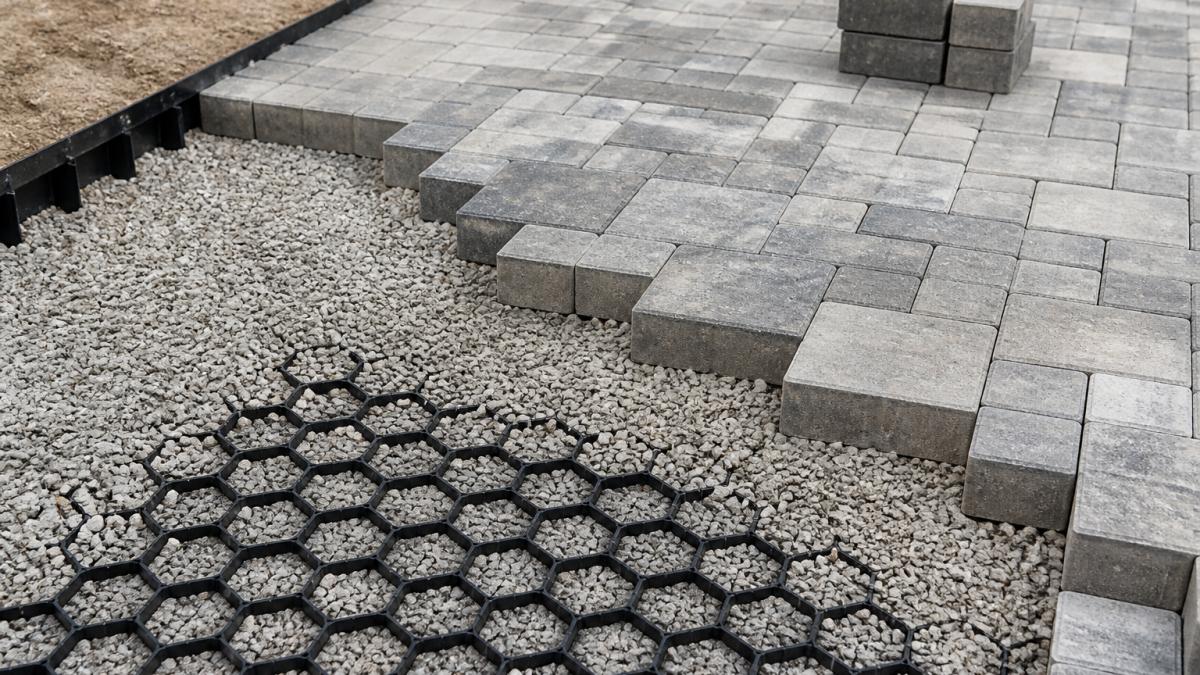
1. Base thickness and gradation. Residential driveways typically use an open-graded aggregate base 8-12 inches deep over compacted subgrade, with exact depth set by soil infiltration rate and expected loads; commercial or fire-access driveways often need more. A base that is too thin or uses dense-graded aggregate will not store and infiltrate stormwater as intended.
2. Paver unit strength and thickness. Standard 2 3/8-inch (60 mm) concrete pavers are common for residential driveways; heavier loads or frequent commercial traffic usually call for 3 1/8-inch (80 mm) units.
3. Joint aggregate specification. The joint is the infiltration path and must be clean, washed, open-graded aggregate in the manufacturer’s specified size range. Anything finer or contaminated with fines will clog faster.
4. Traffic pattern and load distribution. Driveways concentrate loads in wheel paths, which see more compaction and fines migration than the rest of the surface.
How Permeable Paver Driveways Compare to Alternatives
| Surface | Infiltration | Load capacity | Maintenance profile |
|---|---|---|---|
| Permeable interlocking concrete pavers | High, through joints and base | Good for residential; specify thicker units for heavy loads | Vacuum sweep every 2-3 years; joint top-off twice yearly |
| Pervious concrete | High, through the slab | Good, but limited repairability | Vacuum sweep; difficult to patch |
| Porous asphalt | Moderate to high | Good | Vacuum sweep; surface raveling over time |
| Conventional pavers on sand | None | Good | Re-sand joints, occasional sealing |
| Concrete or asphalt | None | Good | Crack sealing, patching, resurfacing |
The paver-specific advantage is repairability: if a section settles or clogs beyond recovery, individual units can be lifted, the base re-graded, and the pavers reinstalled. Pervious concrete and porous asphalt do not offer that option.
Durability Expectations
Quality concrete or porcelain pavers routinely last 25 years or more under residential driveway conditions. The limiting factor is almost never the paver unit but the base and joint aggregate: a driveway vacuum-swept on schedule and topped off with the correct aggregate can maintain strong infiltration for 15-20 years, while one never maintained can lose most of its capacity within 3-5 years, especially under tree canopy or near exposed sandy soil.
Everyday Usability
- Walking and rolling. A well-installed permeable paver driveway is comfortable to walk on and manageable for wheelchairs, strollers, and rolling luggage; joints are typically narrow enough not to catch small wheels.
- Traction. Textured concrete and porcelain pavers offer good wet traction; smooth finishes are a poor choice for sloped driveways in rainy climates.
- Vehicle loads. Passenger vehicles, SUVs, and light delivery vans are well within design range. Repeated heavy loads (dumpsters, concrete trucks, loaded trailers) require a thicker base and heavier paver units.
A permeable paver driveway is a system, not a surface. The pavers are the visible part, but the base, joint aggregate, and maintenance schedule are what determine whether the driveway still infiltrates in year 15. Specify all four, and get the maintenance plan in writing.
Questions to Ask Before You Commit
- What is the measured infiltration rate of my native soil, and how was it tested?
- What base depth and aggregate gradation are specified for my driveway, and why?
- What paver thickness and joint width are specified for my expected loads?
- Where does overflow go if the system is overwhelmed during an extreme storm?
- What is the recommended vacuum-sweeping interval for my site, and who performs it?
- Is there an underdrain, and if so, where does it discharge?
If a contractor cannot answer these questions with specifics, the design is not finished.
Is a Permeable Paver System Right for Your Property?
Deciding whether to install a permeable paver system requires honest assessment of your site conditions and maintenance commitment. Ask:
Does your property have drainage problems? If you experience standing water, basement seepage, or erosion after rain, a permeable paver system can help, but only if soil conditions support infiltration. Poor drainage caused by clay soil won’t be solved by permeable pavers alone.
Are you willing to maintain the system? Professional cleaning every 2-3 years is non-negotiable for long-term performance.
What’s your timeline? If you need reliable performance for 20+ years with minimal intervention, permeable pavers are risky.
At Venice Pavers, we help property owners work through these questions during the site assessment phase.
Permeable paver systems offer genuine environmental benefits and solve real drainage problems, but they’re not a universal solution.
Frequently Asked Questions
How do permeable pavers work to reduce stormwater runoff?
Permeable pavers feature a porous surface and joints filled with open-graded aggregate that allow water to pass through instead of running off the surface. Water infiltrates through the paver joints and into the permeable base layer below, where it filters through aggregate and soil. This infiltration reduces the volume and speed of runoff reaching storm drains and local waterways, which decreases flooding risk and erosion. The system also allows groundwater recharge by letting water percolate into the soil naturally.
What are the main disadvantages of permeable paver systems?
The primary drawback is clogging: fine sediment and debris can fill the joints and porous surface over time, reducing infiltration capacity. Maintenance is more demanding than traditional pavers, you need regular vacuum cleaning to prevent performance loss. Permeable pavers are not suitable for all soil types; clay and compacted soils with poor infiltration rates can cause water pooling. Installation costs are higher due to specialized base preparation and drainage design. They also perform poorly on steep slopes or in areas with high-speed surface runoff.
Do permeable pavers require more maintenance than regular pavers?
Yes, permeable paver maintenance is more intensive. While regular pavers need occasional sweeping and weed control, permeable pavers require regular vacuum cleaning to clear the joint aggregate of sediment and debris. Without this maintenance, the joints clog and the system loses its infiltration capacity, defeating the environmental and drainage benefits. Maintaining long-term durability and performance requires consistent attention to the system’s needs.
Are permeable pavers worth the investment for driveways?
That depends on your site conditions and priorities. Permeable pavers for driveways offer genuine stormwater and environmental benefits, especially in areas with drainage issues, flooding risk, or strict stormwater regulations. They can handle vehicle traffic if installed with a proper permeable base and adequate subgrade support. However, the higher installation cost and ongoing maintenance demands mean they’re best suited to homeowners committed to long-term care and those who value environmental performance. Professional site assessment is essential to confirm your soil type and drainage capacity can support the system.