Explore 7 driveway paver patterns designed for small spaces. Learn which layouts maximize visual appeal and functionality in compact driveways.
Last Updated: October 25, 2026
Quick Summary
Driveway paver patterns are layouts that shape how the eye moves across a small space, affecting both aesthetics and durability. Linear patterns like running bond make a narrow driveway feel longer, while herringbone creates strength through angled interlocking pavers. Larger paver formats reduce visible joints and visual clutter, making compact spaces feel more open and refined.
- Herringbone requires at least 10 feet of width to establish a clear visual rhythm in small spaces.
- Running bond is the fastest pattern to install with fewer cuts and less waste than other options.
- Larger pavers mean fewer joints and a cleaner appearance that makes small driveways feel more spacious.
- Base preparation and drainage are more critical on small driveways because water has fewer places to escape.
- Stick to one or two patterns and a limited color palette to avoid visual overload in compact spaces.
Table of Contents
- Why Driveway Paver Patterns Matter for Small Spaces
- Herringbone Paver Pattern Driveway: Strength and Visual Impact
- Running Bond: A Linear Layout That Guides the Eye Outward
- Basketweave Pattern: Balanced Design for Compact Driveways
- Stack Bond and Modular Arrangements: Clean, Minimal Lines
- Paver Size for Driveway: Why Larger Formats Reduce Visual Clutter
- Paver Driveway Base Preparation: The Foundation for Long-Term Performance
- Small Driveway Paver Ideas: Mixing Colors and Patterns Strategically
- Getting Started With Your Small Driveway Project
- Frequently Asked Questions
Why Driveway Paver Patterns Matter for Small Spaces
A small driveway doesn’t have to feel cramped. The right driveway paver patterns can make a narrow space look intentional, open, and larger than it is.
Pattern choice affects more than aesthetics: it shapes how the eye moves across the space, how pavers perform under vehicle weight, and how much cutting and waste occurs during installation.
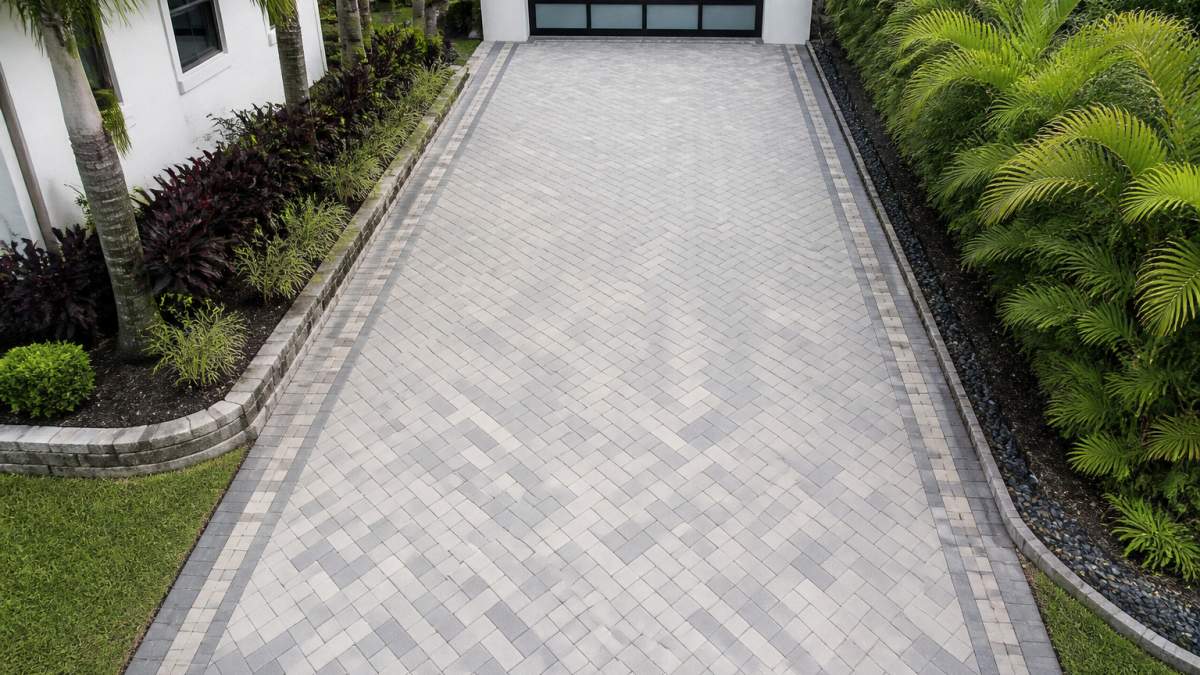
Linear patterns guide the eye outward, making a space feel longer. Similarly, larger pavers reduce visible joints and visual clutter. The right pattern can also cut installation complexity and material waste, affecting your timeline and budget.
Below are seven proven paver patterns for small driveways, each with specific advantages for compact spaces, installation expectations, and best-fit situations.
Herringbone Paver Pattern Driveway: Strength and Visual Impact
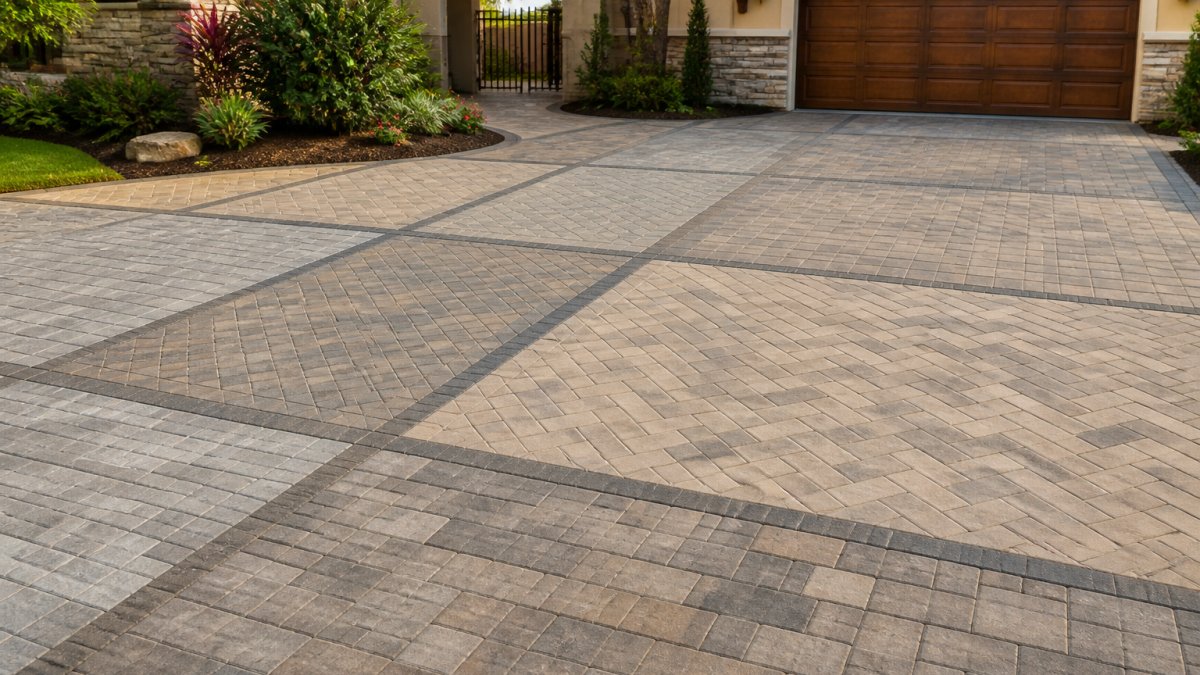
Herringbone creates a V-shaped weaving pattern where each paver sits at a 45-degree angle to its neighbor. This layout locks pavers tightly together, which is why it’s a top choice for driveways where vehicle traffic is constant.
The strength comes from the interlock: angled pavers brace against each other under load, distributing weight across multiple pavers instead of concentrating it on a single line. For a small driveway with daily traffic, this matters.
Herringbone requires more edge cuts, since your installer must trim pavers to fit the perimeter. That adds labor time and some waste, but the angled lines draw the eye forward and outward, making even a narrow driveway feel dynamic.
The pattern works best when the driveway is at least 10 feet wide. Below that, the herringbone effect gets lost because the pavers don’t have room to establish a clear rhythm. If your space is tighter, consider a different layout.
Running Bond: A Linear Layout That Guides the Eye Outward
Running bond is the simplest linear pattern. Pavers stack in straight rows, with each row offset by half a paver width from the row above it. Think of a brick wall, that’s running bond.
This pattern guides the eye straight down the driveway. Linear patterns naturally lead vision forward, which makes your space feel longer than it actually is. For a compact driveway, that visual extension is valuable.
Running bond is also the fastest to install. In addition, fewer cuts mean less labor, less waste, and a quicker timeline, and the straightforward layout reduces installation errors that could compromise base preparation and drainage.
The downside is subtlety: running bond feels familiar and safe but lacks the visual interest of herringbone or basketweave. If you want a design statement, it’s understated; if you want fast, reliable, and clean, it delivers.
Basketweave Pattern: Balanced Design for Compact Driveways
Basketweave alternates between pairs of pavers laid horizontally and vertically, creating a woven appearance. Two pavers sit side-by-side in one direction, then two pavers sit side-by-side perpendicular to them. The pattern repeats across the entire surface.
Basketweave works well for small spaces because it adds visual interest without overwhelming a narrow footprint, breaking up linear monotony while keeping the layout organized.
It requires more cutting than running bond, especially at edges and corners, so your installer must plan the layout so partial pavers at the perimeter don’t look awkward. When done well, basketweave is striking; when done poorly, it looks rushed.
Basketweave is also slightly less load-bearing than herringbone because the perpendicular orientation doesn’t create the same interlock strength. For a residential driveway with normal car traffic, this isn’t a problem. For heavy commercial use, however, herringbone is the safer choice.
Stack Bond and Modular Arrangements: Clean, Minimal Lines
Stack bond is the most minimal pattern. Pavers line up in a grid, with each paver directly above and beside the one next to it. No offset, no angle, just clean rows in both directions.
The straight lines feel intentional and contemporary, and for a small driveway the orderly layout prevents visual chaos and makes the space feel controlled.
Still, stack bond does have a structural weakness. The straight joints create planes of weakness where pavers can shift under load. For example, heavy traffic can cause pavers to settle unevenly.
Modular arrangements combine different paver sizes in a planned layout, alternating large and small pavers or mixing rectangular and square formats. The key is intentional planning so the sizes work together rather than looking random.
Modular patterns require precise layout planning before installation to avoid gaps and excessive cutting. When executed well, they feel sophisticated and custom.
Paver Size for Driveway: Why Larger Formats Reduce Visual Clutter
Paver size directly affects how a small space feels. Larger pavers mean fewer joints. Fewer joints mean less visual clutter and a cleaner appearance.
A small driveway with tiny pavers (say, 4×8 inches) looks busy and fragmented, since your eye lands on the joints as much as the pavers, making the space feel cramped.
Larger pavers (12×24 inches or bigger) create visual continuity. That way, your eye sees the surface as a unified plane rather than a collection of separate pieces.
The tradeoff is installation precision: larger pavers need a more stable base, and any settlement becomes visible, making paver driveway base preparation even more critical.
Free consultation & estimate →
Large-format pavers cost more per unit, but because you need fewer to cover the same area, total material cost sometimes comes out similar. Ask your installer for a cost comparison before deciding.
Paver Driveway Base Preparation: The Foundation for Long-Term Performance
No pattern matters if the base fails. For a driveway, the base is not the same as a patio base.
Base preparation includes excavation, grading, compaction, and edge restraint, each with driveway-specific requirements.
Excavation and subgrade. First, excavation removes topsoil and unstable material.
Grading and drainage. Grading slopes the base slightly for drainage, typically a 1-2% slope to move water away from the driveway and away from the home (How to Install Pavers on a Slope).
Compaction. Mechanical equipment densifies the base material to prevent settlement.
Edge restraint. Edge restraint keeps pavers from spreading outward under traffic. Otherwise, the outer rows gradually shift and separate.
Paver thickness and load. For residential driveways, paver thickness matters: car traffic calls for a thicker paver than a patio, since thicker pavers resist bending and point loads better.
Drainage and permeable considerations. On a small driveway, water has fewer places to go.
On a small driveway, the most common failure is not the pattern, it is water. Confirm where water will go before the base is built, not after the pavers are laid.
At Venice Pavers, we treat base preparation as the most important part of any driveway project: invisible when it works, catastrophic when it doesn’t.
Small Driveway Paver Ideas: Mixing Colors and Patterns Strategically
Color and pattern work together. The right combination makes a small driveway feel intentional, while the wrong one makes it feel chaotic.
Neutral colors recede visually. Greys, taupes, and warm browns create a calm backdrop that makes the space feel larger because your eye isn’t drawn to color contrast.
Accent colors work best as borders or focal points. A darker border around the perimeter frames the space and adds definition.
Pattern mixing requires restraint. Two patterns in a small space is possible, but three or more creates visual overload. Use them in distinct zones, perhaps herringbone in the main area and running bond for a border, and keep the palette consistent so the transition reads as intentional.
Match the home’s architecture. Modern homes pair well with clean lines and neutral tones, while traditional homes can handle more elaborate patterns and warmer colors.
Compare patterns on practical criteria, not just looks. The table below compares the seven patterns on the factors that matter for a small driveway. Use it to narrow the choice before you look at samples.
| Pattern | Visual effect in a small space | Installation complexity | Cutting waste | Suitability for vehicle traffic |
|---|---|---|---|---|
| Herringbone | Strong interlock, dynamic angled lines | Higher | Moderate to high at edges | High |
| Running bond | Linear, makes space feel longer | Low | Low | Moderate to high |
| Basketweave | Balanced, woven look | Moderate | Moderate | Moderate |
| Stack bond | Clean, minimal grid | Low to moderate | Low | Lower; straight joints can shift |
| Modular | Custom, sophisticated | High | Moderate to high | Moderate to high |
| Large-format | Fewer joints, cleaner plane | Moderate to high | Moderate | Moderate to high |
| Mixed patterns | Zones of interest | High | High | Varies by zone |
Maintenance and repair. Joint maintenance matters more on a small driveway because there is less surface area to absorb wear.
Cost factors. Pattern complexity affects cost through cutting, labor, and waste.
The best approach is to explore available paver driveway options with your installer, who can show samples in natural light and help you visualize combinations at your property’s scale.
Getting Started With Your Small Driveway Project
Choosing the right driveway paver pattern for a small space comes down to balancing visual impact, installation practicality, and long-term durability. Linear patterns like running bond maximize the sense of space. Herringbone provides strength and visual interest. Large-format pavers reduce clutter. And meticulous base preparation ensures everything performs as designed.
The challenge is translating these principles to your specific driveway. Every property has unique grading, drainage, and traffic patterns. As a result, a pattern that works beautifully on one driveway might not suit another.
Venice Pavers specializes in designing custom hardscape solutions tailored to small spaces. We start with a thorough site evaluation, checking drainage, grading, and traffic patterns, then recommend patterns and materials that work specifically for your property.
Schedule a free consultation to discuss your driveway project and explore which patterns and materials make sense for your space.
Frequently Asked Questions
Which paver pattern makes a narrow driveway look wider?
Running bond and diagonal herringbone patterns create directional lines that lead the eye outward, making a compact driveway feel more spacious. Linear layouts work especially well because they minimize visual breaks and guide focus along the length of the space. Avoid random or heavily fragmented patterns in narrow areas, as they can make the space feel busier and smaller.
What paver size for driveway works best in small spaces?
Larger-format pavers reduce the number of joints and visual breaks across your driveway surface. Fewer grout lines mean fewer visual interruptions, which makes a compact area feel more open and cohesive. Smaller pavers create more visual clutter through increased joint patterns, which can make a narrow driveway feel cramped. Choosing larger rectangular or square pavers is one of the most effective design strategies for small spaces.
Are herringbone pavers a good choice for driveways?
Yes, herringbone is an excellent driveway paver pattern because the interlocking diagonal layout distributes vehicle weight evenly across the surface, creating exceptional load-bearing capacity. The pattern also adds visual interest and sophistication to a driveway. However, herringbone requires more precise cutting at edges and slightly more complex installation than linear patterns, which may affect labor costs. For small spaces, herringbone works well because the diagonal lines create movement that makes the area feel larger.
What base preparation does a paver driveway need?
Paver driveway base preparation is critical for durability and drainage. The process typically involves excavation to proper depth, compaction of the subgrade, installation of a stable base layer (usually crushed stone or gravel), and proper grading to ensure water flows away from the driveway. Inadequate base preparation leads to settling, shifting, and drainage problems. Professional contractors prioritize meticulous base work and drainage planning because it determines whether your paver driveway remains stable and functional for decades.
A small driveway is a design opportunity, not a limitation. The right pattern makes your property feel intentional and well-maintained. Venice Pavers has spent over 30 years perfecting base preparation and drainage planning for compact driveways. We’ll help you choose a pattern that works, install it correctly, and stand behind the work with our lifetime workmanship guarantee.