Table of Contents
- The 7 Most Common Reasons Paver Driveways Crack
- Poor Base Preparation and Compaction
- Soil Movement and Shifting Subgrade
- Poor Drainage and Water Accumulation
- Heavy Vehicle Loads and Weight Distribution
- Signs of Paver Base Failure You Should Never Ignore
- How to Prevent Sinking Pavers and Cracking Before It Starts
- Repair or Replace? A Decision Matrix for Cracked Pavers
- Replacing Individual Driveway Pavers: A Step-by-Step Guide
- Why Edge Restraint Failure and Tree Roots Are Missed Causes
- Conclusion
- Frequently Asked Questions
Last Updated: October 2, 2026
The 7 Most Common Reasons Paver Driveways Crack
Paver driveways crack when the layers beneath them stop doing their job. The pavers themselves are rarely the problem. At Venice Pavers, we’ve spent more than 30 years installing hardscape across Southwest Florida, and the same handful of root causes show up again and again.
The seven reasons: poor base preparation and compaction, soil movement and a shifting subgrade, poor drainage and water accumulation, heavy vehicle loads and weight distribution, tree root intrusion, edge restraint failure, and impact damage. Most cracked driveways trace back to two or three of these working together.
Below, we’ll walk through each cause, show you how to spot it, and explain what it takes to fix it properly.
Poor Base Preparation and Compaction
The base layer is the compacted aggregate bed beneath your pavers, and it carries every pound that rolls across the driveway. When a contractor skips proper compaction, the base settles unevenly and the pavers above it crack.
Compaction happens in lifts, meaning the crushed stone goes down in shallow layers and gets tamped before the next one goes on. Rushing that step is the single most common shortcut we see. A driveway that fails in year two almost always had a base problem in week one.
Soil Movement and Shifting Subgrade
The subgrade is the native soil under your base layer, and it decides how stable everything above it stays. Sandy soils drain well but shift under load. Clay-heavy soils hold water and swell, then shrink and leave voids.
Because the soil here is often sandy and the water table sits high, a subgrade that isn’t graded and stabilized correctly will move seasonally. When it moves, the base moves with it, and pavers crack along the stress lines.
Poor Drainage and Water Accumulation
Water is the most destructive force acting on a paver driveway. When runoff can’t escape, it pools in the base, saturates the subgrade, and creates hydrostatic pressure that pushes pavers up and apart.
A properly built driveway has a drainage slope that moves water off the surface and away from the edges. Without it, you get standing water after every storm, and eventually heaving and cracking. If your driveway holds puddles hours after rain stops, that’s your answer.
Heavy Vehicle Loads and Weight Distribution
A paver driveway doesn’t fail because a heavy vehicle touched it once. It fails because the load path from the tire down through the paver, the bedding sand, and the aggregate base was never sized for that load in the first place.
Here’s the mechanism. When a tire rolls over a paver, the load spreads downward at roughly a 45-degree angle through the base. A passenger car puts about 1,500 to 2,000 pounds on each axle. A loaded dumpster truck or concrete mixer can push 20,000 pounds or more onto a single axle, ten times the load, concentrated on the same footprint. If the base isn’t thick enough to spread that load before it reaches the subgrade, the subgrade deflects, the base follows, and the paver above it bends until it snaps. Most paver cracks from overload start at the bottom of the paver, not the top.
Static versus dynamic loads matter too. A parked vehicle is a static load, constant, predictable, and easy to design for.
A common pattern in failed driveways: the base was built to a one-size-fits-all depth, the homeowner later bought an RV or started parking a work truck, and the driveway cracked within two seasons. The pavers weren’t defective. The base was undersized for the load it was actually asked to carry.
Signs of Paver Base Failure You Should Never Ignore
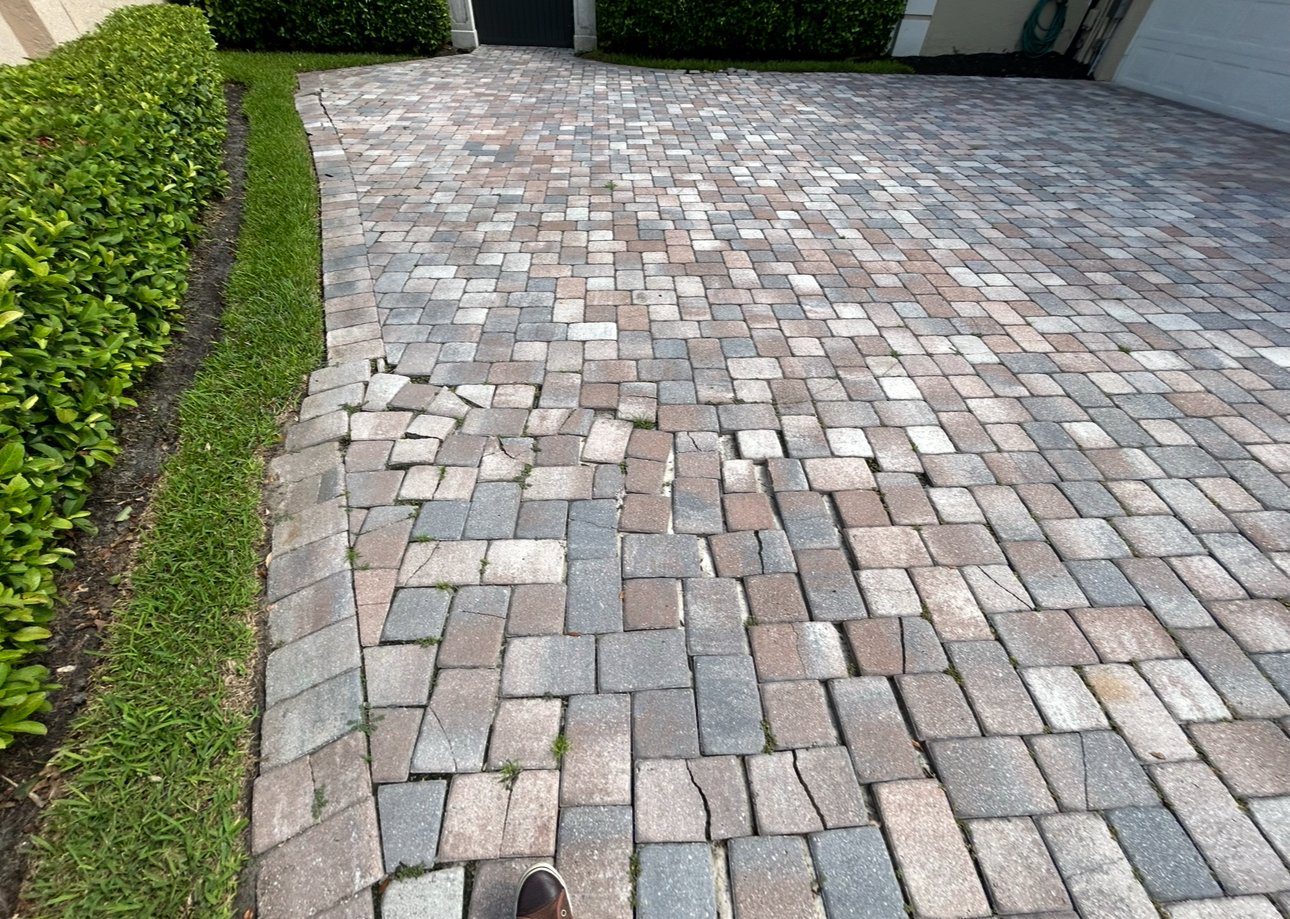
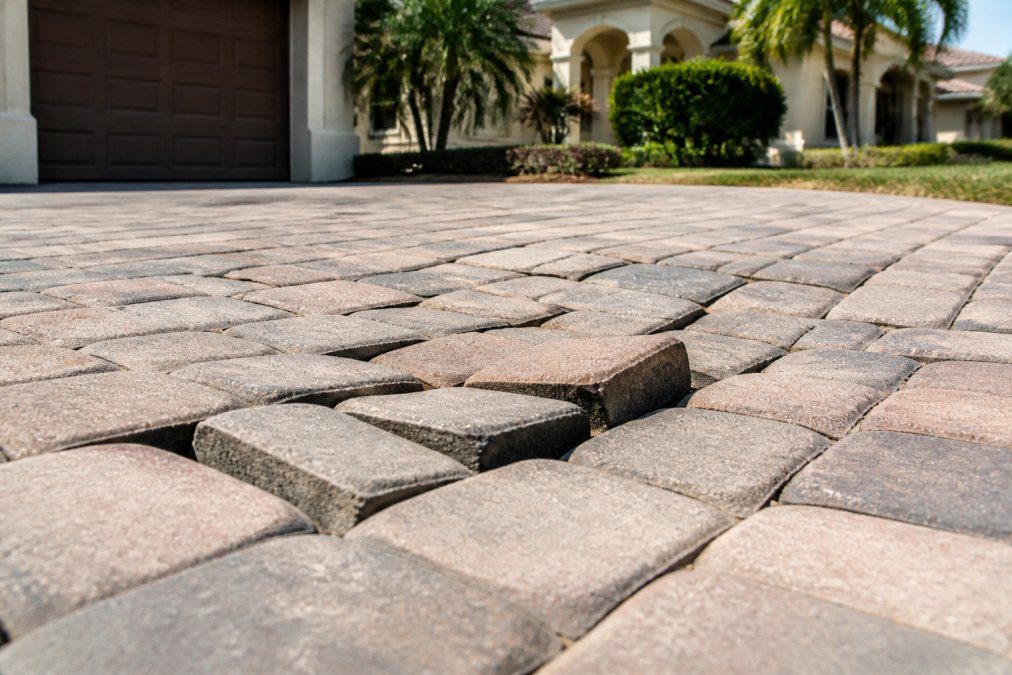
The earliest sign of base failure is movement, not cracking. If pavers rock when you step on them or sit lower than their neighbors, the base has already started to fail. Cracking comes later.
Free consultation & estimate →
Watch for these warning signs:
- Pavers that wobble or sound hollow underfoot
- Hairline cracks spreading from a single point
- Sunken areas or depressions that collect water
- Joint sand washing out between pavers
- Edges pulling away from the driveway border
- A slope that feels different from one season to the next
How to Prevent Sinking Pavers and Cracking Before It Starts
Preventing sinking pavers comes down to three things: a properly compacted base, correct drainage, and secure edge restraints. Get those right at installation and most cracking never happens.
- Excavate to the correct depth for your soil and expected loads
- Compact the subgrade and confirm it’s level
- Lay and compact the aggregate base in shallow lifts
- Set a drainage slope that sheds water away from the structure
- Install edge restraints anchored into the base
- Sweep polymeric sand into the joints and activate it
Repair or Replace? A Decision Matrix for Cracked Pavers
Not every cracked paver means a new driveway. Use the scope of the damage to decide.
|
What You’re Seeing |
Likely Cause |
Best Move |
|---|---|---|
|
One or two cracked pavers, rest solid |
Impact damage |
Replace individual pavers |
|
A cluster of cracks with rocking pavers |
Localized base failure |
Rebuild that section’s base |
|
Cracks along a straight line |
Edge restraint failure |
Reset and re-anchor the edge |
|
Widespread sinking and cracking |
Subgrade or drainage failure |
Full reinstallation |
|
Cracks near a tree |
Root intrusion |
Root barrier plus rebuild |
Replacing Individual Driveway Pavers: A Step-by-Step Guide
Replacing individual driveway pavers is a straightforward job when the base beneath them is still sound. If it isn’t, you’re wasting your time on a cosmetic fix.
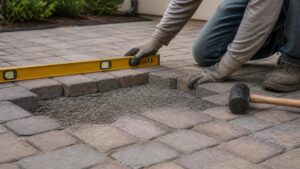
- Match the paver. Confirm the exact size, thickness, and color of your existing pavers.
- Remove the damaged unit. Pry it up carefully to avoid chipping the neighbors.
- Inspect the base. If the aggregate is loose or wet, dig it out and recompact.
- Reset the bedding layer. Level a thin sand bed to the correct height.
- Set the new paver. Tap it flush with the surrounding surface.
- Fill the joints. Sweep in polymeric sand and activate it per the manufacturer’s instructions.
- Compact and check. Run a plate compactor over the area and confirm it’s level.
Why Edge Restraint Failure and Tree Roots Are Missed Causes
Two causes get overlooked more than any others: edge restraint failure and tree root intrusion. Both crack pavers from the outside in, both get misdiagnosed as base problems, and both are easy to confirm once you know what to look for.
Edge Restraint Failure: The Cause Nobody Checks
Edge restraints are the concrete, plastic, or aluminum profiles that lock the outer row of pavers in place. They’re the only thing stopping the driveway from spreading outward under load. Without them, or with undersized, unanchored, or rotted ones, every vehicle that rolls over the driveway pushes the pavers slightly outward. The joints open, sand washes out, and the outer pavers lose their interlock with the field.
Common edge restraint failure modes:
- No restraint at all. Some installers bury the outer row in soil and call it done. It isn’t.
- Restraint not anchored into the base. A restraint sitting on top of the base instead of spiked through it will lift and shift.
- Plastic restraint in a freeze-affected or high-load application. Plastic can crack or deform; concrete or aluminum holds up better under heavy loads.
- Restraint installed too shallow. It needs to be set so the paver’s edge is captured, not just touching.
Tree Root Intrusion: The Slow Lift
Tree roots seek water, and a paver driveway’s base is often the wettest, loosest soil on the property. Roots grow under the base, lift it, and create voids that the pavers settle into. The result is a localized hump or dip, followed by cracking as the pavers lose support.
Conclusion
A cracked paver driveway is a symptom, not the disease. The real cause is almost always underneath: a base that wasn’t compacted in lifts, soil that moves, water that can’t drain, or an edge that was never anchored properly. Diagnose the cause before you spend money on repairs, or you’ll be fixing the same spot again next year.
Frequently Asked Questions
What is the lifespan of a paver driveway?
A properly installed paver driveway can last 25 to 50 years or more. The pavers themselves often outlast the base, which is why base preparation matters so much. When the base fails, pavers shift and crack even if the stones are still in good condition. Regular maintenance like re-sanding joints and checking edge restraints extends the life of the system.
Can you repair a cracked paver without replacing the whole driveway?
Yes, in many cases you can repair a cracked paver by replacing individual stones. If the crack is isolated and the base underneath is stable, a single paver swap takes less than an hour. However, if cracks appear in a pattern across multiple pavers, the base layer itself may be failing, which requires a larger repair or full re-installation.
Do paver driveways crack more or less than poured concrete?
Paver driveways crack less often than poured concrete because the individual units flex slightly with soil movement. Concrete is rigid and cracks when the ground shifts beneath it. That said, pavers are not immune. Poor base preparation, drainage issues, or heavy loads can still cause cracking, which is why installation quality matters more than the material choice alone.
How does poor base preparation lead to paver failure?
The base layer distributes weight and keeps pavers level. When contractors skip proper compaction or use too little crushed stone, the subgrade shifts under load. This causes pavers to sink, heave, and crack. A base that is not compacted to the right depth and density will fail within a few seasons, especially in areas with high water tables or sandy soil.